How to Promote Your Podcast: 15 Proven Strategies to Grow Your Audience
 Stacey Corrin
Stacey Corrin
Stacey Corrin
 John Turner
John Turner
John Turner
TL;DR: How to Promote Your Podcast
Promoting your podcast takes a mix of quick distribution wins and long-term audience-building tactics. Here are the key moves:
- Submit to directories – Get on Apple Podcasts, Spotify, and other major platforms so listeners can find you wherever they listen.
- Build a landing page – A dedicated page with episode links and a subscribe CTA converts curious visitors into regular listeners.
- Run a giveaway – A RafflePress giveaway with a “subscribe to podcast” entry action can rapidly grow your subscriber count.
- Create audiograms – Short 60-90 second clips with captions perform well on Reels, TikTok, and YouTube Shorts and pull in new listeners.
- Optimize for SEO – Write episode-specific show notes with target keywords so each episode can rank in search.
- Email your list – Regular episode updates to an email list keep existing listeners coming back and reduce churn.
You launched your podcast. You’ve put out a few episodes. And now you’re checking your stats every day, watching the download numbers barely move.
I’ve been in that spot, and it’s frustrating because the problem usually isn’t your content. It’s that you haven’t built a promotion system yet.
In this guide, I’ll show you exactly how to promote your podcast using proven podcast marketing strategies so more people discover it and keep coming back for new episodes. Most of these strategies cost nothing, which makes them a solid starting point if you’re looking to promote a podcast for free.
With over 584.1 million podcast listeners worldwide as of 2025, the audience is there. You just need to reach them.
How to Promote Your Podcast: 15+ Top Strategies
These podcast promotion tips are designed to help you increase podcast listeners and grow your audience over time.
- 1. Release Multiple Podcast Episodes on Launch Day
- 2. Publish New Episodes at Strategic Times
- 3. Submit Your Show to Podcast Directories and Aggregators
- 4. Ask Your Podcast Listeners to Subscribe and Share
- 5. Run an Online Giveaway to Grow Your Podcast Audience
- 6. Create a Dedicated Podcast Landing Page
- 7. Create Audiograms and Short-Form Video Clips
- 8. Optimize Your Podcast Website for SEO
- 9. Transcribe Podcast Episodes Into Blog Posts
- 10. Use Exit Popups to Capture Potential Listeners
- 11. Feature Your Podcast in Your Email Newsletter
- 12. Leverage Word-of-Mouth and Referral Marketing
- 13. Cross-Promote Podcast Episodes Across Social Platforms
- 14. Turn Podcast Audio Into Short YouTube Videos
- 15. Ask Guest Speakers to Share Episodes With Their Audience
- 16. Be a Guest on Other Podcasts
- 17. Set Up Podcast Cross-Promotions and Trailer Swaps
1. Release Multiple Podcast Episodes on Launch Day
If you’re at the beginning of your podcasting journey, creating at least 3 episodes before you launch is a good idea.
If you don’t have many episodes for new listeners to explore, they won’t have enough time to get invested in your show. They’ll lose interest quickly and move on.
Create anywhere from 3 to 5 episodes so listeners can binge your podcast at the start. This gives them a taste of your content and style and encourages them to keep listening.
2. Publish New Episodes at Strategic Times
Before launching, check out other podcasters and see when they publish their content. If you see a pattern in their posting times and frequency, there’s likely a good reason behind it.
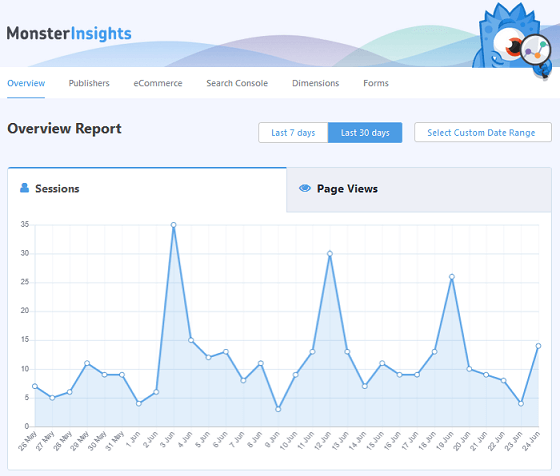
Follow that pattern for your show and start collecting data you can analyze later. Then go back through your podcast analytics, see when people listen the most, and adapt your posting schedule to reach them.
Most podcast hosting services offer built-in analytics so you can see listener trends. If you host your podcast in WordPress, you can use a tool like MonsterInsights, the best WordPress Google Analytics plugin, to see how users interact with your podcast.
3. Submit Your Show to Podcast Directories and Aggregators
After launching your podcast, you’ll want to expand your reach to as many listeners as possible. One of the best ways to do that is to submit your podcast to the major podcast directories and aggregators as part of your overall distribution strategy.
The most popular podcast aggregator is Apple Podcasts. It’s the default podcast app on iOS, but plenty of other aggregators cater to a broader range of users.
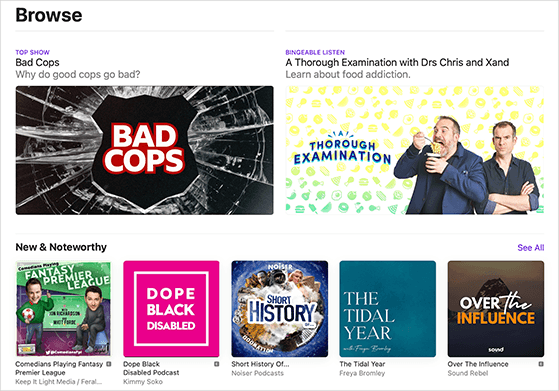
Other popular podcast aggregators include:
- Spotify
- SoundCloud
- Podbay
- TuneIn
- Stitcher
You can create an account on these platforms and submit your podcast RSS feed. That way, all of your new episodes are published on their platforms automatically.
Doing this exposes your podcast to a new audience as they browse for exciting content.
4. Ask Your Podcast Listeners to Subscribe and Share
One of the easiest ways to grow your podcast audience is to record an introduction and conclusion at the beginning and end of each episode. In these sections, you can prompt listeners to subscribe and share your latest episode on social media.
Be authentic when you do this. Explain that as you grow, you can offer better content your whole audience can enjoy.
Reviews matter just as much as subscriptions. On Apple Podcasts specifically, early ratings are a ranking signal that helps new listeners find your show. The best moment to ask is right after a strong episode, when the listener is still engaged and the content is fresh.
Try a simple two-week reviews sprint when you launch or re-launch: ask for a review at the end of each episode for two weeks straight, and make it specific.
Tell listeners exactly how to do it. “Open Apple Podcasts, search for [show name], scroll to Ratings and Reviews, and tap Write a Review.” The more frictionless you make it, the more you’ll get.
5. Run an Online Giveaway to Grow Your Podcast Audience
Giveaways are an effective way to build an audience and engage your existing followers. They’re also a strong way to drive targeted traffic to your website.
With a successful giveaway contest, you can simultaneously promote your podcast across multiple platforms, boosting your audience, traffic, and followers. With RafflePress, you can do all of the above.
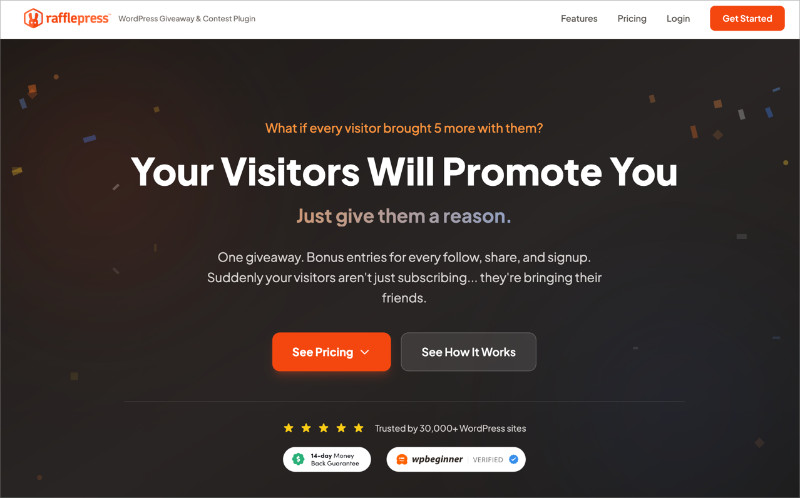
RafflePress is the best WordPress giveaway plugin on the market. With its drag-and-drop giveaway builder, you can spin up giveaways in minutes.
Start with a ready-made giveaway template with entry actions designed to meet your goals. Or, start from scratch and build a custom giveaway tailored to your podcast.
RafflePress offers 1-click giveaway actions that make it easy for people to enter. For example, with the Subscribe to Podcast action, you can require users to subscribe to your podcast for a chance to win a prize.
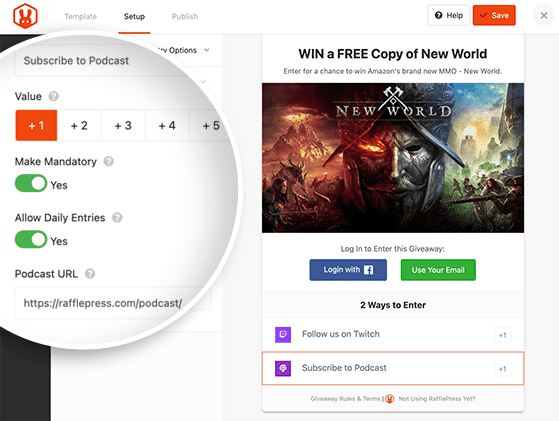
You can include bonus actions to follow your social media channels, including LinkedIn, Facebook, X (formerly Twitter), refer a friend, and more. Plus, with popular email integrations, you can quickly run a giveaway to grow your email list.
Check out this step-by-step guide to learn how to run a giveaway with RafflePress.
6. Create a Dedicated Podcast Landing Page
Another effective way to promote your podcast is to create a dedicated podcast landing page. This type of page is a standalone web page that encourages users to listen to your show or become loyal podcast subscribers.

If you can get users to listen to just one promo episode, you have a much better chance of converting them. Fill your page with information to help them make that decision, including:
- Benefit-driven headlines that describe your podcast
- A description that explains your show and the benefits users get from listening
- Positive reviews and testimonials from satisfied listeners
- Links to recent episodes
- Call to action (CTA) buttons to subscribe to your podcast
If you’re unsure where to start, our friends at SeedProd have a step-by-step tutorial for creating a podcast landing page.
7. Create Audiograms and Short-Form Video Clips
Audiograms are short episode clips, usually 60 to 90 seconds, that combine your audio with a waveform animation and captions. They perform well on Instagram Reels, TikTok, and YouTube Shorts because the format is native to those feeds.
The clips that pull in new listeners are the ones that share a single strong moment: a surprising stat, a blunt opinion, or the 30-second answer to a question your audience is already asking. They don’t preview the episode. They deliver value on their own.
Captions are not optional. Most people watch short video without sound, so text on screen is what converts a scroll into a listen.
Tools worth trying for audiogram creation:
- Headliner – Free plan available; good for quick audiogram templates
- Descript – Starts at $12/month; handles transcription, editing, and audiogram export in one tool
- Riverside – Starts at $15/month; built-in clip creator and auto-captions for video recordings
Aim for one audiogram per episode. Pick the best 60-second moment, add captions, and post it on the day the episode drops.
8. Optimize Your Podcast Website for SEO
A podcast website isn’t just a foundation for promoting your show. It’s also an effective way to draw in people searching for the topics you cover.
But it’s hard to attract targeted traffic if you don’t optimize your website for search engines (SEO). This means tailoring your website content, such as blog posts, podcast episodes, and pages, around words people search for.
Check out this post to learn how to do keyword research for your website and improve your podcast SEO.
For each episode, the goal is to write a title that includes a keyword people actually search for. Not just “Episode 42” or a clever phrase, but something like “How to Monetize a Podcast Without Sponsorships.” That title can rank on its own.
Then create a dedicated blog post for that episode with a full set of show notes. A strong show notes page includes:
- An embedded audio player
- A 2-3 sentence description of what the episode covers
- Timestamps for the key topics
- Links to tools and resources mentioned
- A partial transcript (300-500 words is enough to give search engines something to index)
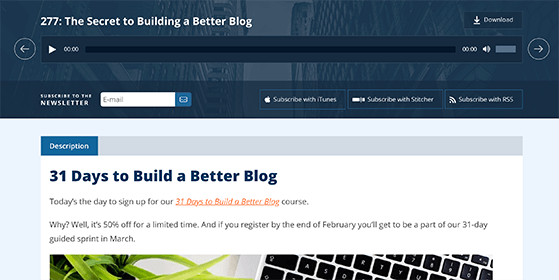
Tailor each post to specific keywords so your episodes appear in search results. If you repeat this process regularly, your content marketing pays off and you start attracting listeners who are already interested in what you cover.
9. Transcribe Podcast Episodes Into Blog Posts
Evergreen content is the cornerstone of a successful marketing strategy. That means content relevant to people no matter how long ago you published it.
When thinking about how to promote your podcast, consider which past episodes fall into the evergreen category. General how-to guides and top 10 lists are strong candidates for repurposing into written posts.
Publishing those episodes as blog posts improves your podcast’s search visibility and attracts long-term traffic. AI transcription tools make this faster than it used to be.
- Otter.ai has a free plan that handles most transcripts in minutes.
- Descript (from $12/month) lets you edit the transcript like a text document and export the audio at the same time.
- Riverside (from $15/month) includes transcription as part of its recording and editing workflow.
10. Use Exit Popups to Capture Potential Listeners
After turning your podcasts into blog posts and optimizing your content, there are still a few things you can do to promote them. One is to capture your audience’s attention when they’re about to leave your website.
The best way to do that is with exit popups, which are lightbox popups that appear just as a user moves their cursor away from your web page. You can present them with a call to action to listen to your podcast or subscribe for new episodes.
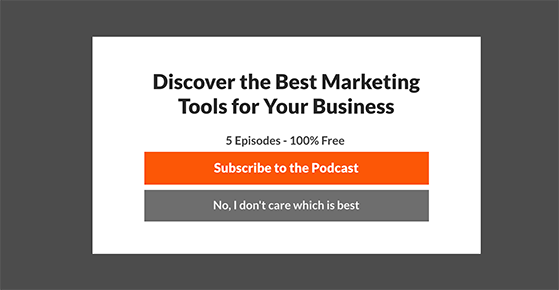
Usually, these users would leave your site and never return. With an exit popup, you can give them one more reason to stay long enough to convert.
Creating exit popups is straightforward with a tool like OptinMonster. Its drag-and-drop campaign builder lets you design, create, and launch popup campaigns in minutes.
Check out this tutorial for using exit popups on your website.
11. Feature Your Podcast in Your Email Newsletter
Email marketing is another effective way to keep your audience engaged with your podcast. According to Litmus, email marketing returns $36 for every $1 spent, making it one of the highest-ROI channels available.
If you haven’t already, start growing your email list. Once you have a list of contacts, you can create an email newsletter promoting your new podcast episodes.

Alongside your podcast episodes, you can use your newsletter to promote any giveaways, deals, and offers. Your audience keeps coming back, and your podcast stays top of mind.
12. Leverage Word-of-Mouth and Referral Marketing
Word-of-mouth marketing is a strong podcast promotion tactic. It involves encouraging satisfied podcast listeners to recommend your show to their friends, family, and broader network.
If you’re already running a giveaway with RafflePress, you can use the refer-a-friend giveaway action to attract referrals.
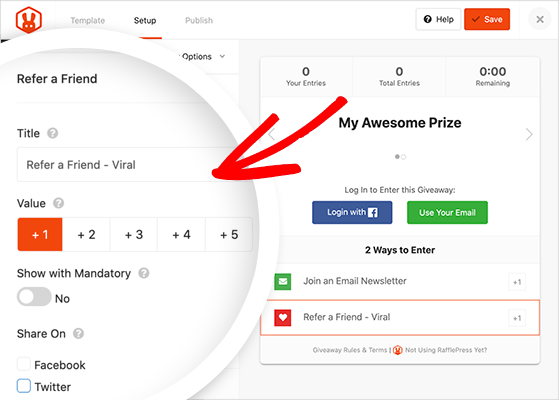
As each person uses that action to enter your giveaway, they’re spreading the word to their wider network, encouraging more people to enter. You end up with many more people who know about your podcast instead of just a handful.
You can also leverage word-of-mouth marketing offline. Find where your audience congregates, such as:
- Conferences
- Meetups
- Local events
Use those events as an opportunity to hand out business cards with your podcast URL.
13. Cross-Promote Podcast Episodes Across Social Platforms
Cross-promoting across channels is a good way to grow podcast downloads and capture new listeners. Since each platform has a different type of audience, exposing those users to your podcast helps you reach beyond your existing fanbase.
Posts move fast in social feeds, so covering all the important channels reduces the odds of people missing your episode.
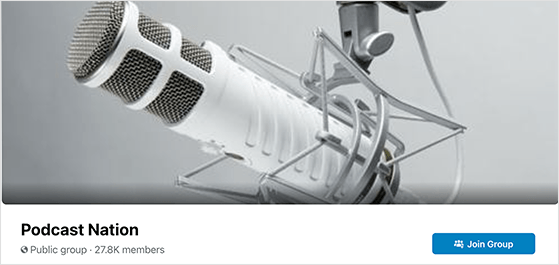
If you post a new episode on X (formerly Twitter), post it on Facebook too. You can even join relevant Facebook Groups and suggest your podcast after contributing to the conversation.
You can even use paid ads, such as Facebook ads, to give your marketing efforts an extra boost.
14. Turn Podcast Audio Into Short YouTube Videos
Earlier in this post, I suggested submitting your podcast to aggregators like Apple Podcasts. But have you considered turning your podcast into videos and publishing them on YouTube?
For this tip, you don’t need fancy video recording equipment. You can convert your podcast MP3 file into an MP4 file format and upload it to your YouTube channel.
From there, create a branded image to display during the episode. In the description, include links to your website and other social platforms.

You can go the route of creating a high-quality video, but if you’re still new, the simpler approach saves time and money while still getting you on the platform.
15. Ask Guest Speakers to Share Episodes With Their Audience
If your show follows an interview format with podcast guests, this is an ideal opportunity to tap into your guest’s audience. Anyone you invite to talk on your podcast likely has a following of their own, so use it to promote your show.
Make it easy for guests to share the episode they appear on. Send them a quick email on the day it goes live with a collection of ready-made shareable media, such as:
- Images
- Quotes
- Links
From there, they can broadcast the episode to their audience, encouraging their followers to listen. You could net many like-minded subscribers ready to binge future episodes.
16. Be a Guest on Other Podcasts
Being a guest on other podcasts is one of the most effective ways to reach new listeners who are already in the habit of listening to podcasts. They’ve self-selected. They’re warm. You just need to show up and be worth following.
Tthe shows that grow fastest from guesting are the ones that treat each appearance as a standalone pitch for their podcast, not a generic interview. You want listeners to finish that episode and go straight to your feed.
To find opportunities, start with podcasts in your niche that interview guests regularly. Look for shows with a similar audience size to yours. Reaching out to shows 10x bigger rarely works when you’re just starting out.
When pitching, keep your email short. One paragraph on who you are, one specific topic you’d cover on their show, and a line on why their audience would care.
Don’t lead with your credentials. Lead with the value your episode brings to their listeners.
After the episode airs, make it easy for people to find you. Include your podcast name and a direct subscribe link in your guest bio.
Share the episode on your own channels and tag the host. The more you promote their show, the more they’ll want to keep the relationship going.
17. Set Up Podcast Cross-Promotions and Trailer Swaps
A trailer swap is where two podcasters agree to play a short promotional clip from each other’s show in an upcoming episode. It’s free, it reaches an audience that already listens to podcasts, and it takes about 60 seconds of airtime to pull off.
The key is finding shows with a complementary but non-competing audience. A marketing podcast and a freelance business podcast, for example, share listeners but aren’t fighting for the same niche.
To find swap partners, try Podmatch, which matches podcasters for guest appearances and cross-promotions. Podcasting Facebook groups are another solid source. Search for active communities in your niche and look for hosts who are already talking about growth.
When pitching a swap, keep it specific. Name the episode you’d want them to promote, what you’d play from their show, and when you’re thinking of running it. A vague “want to collaborate?” email rarely gets a response. A specific proposal with dates does.
Best Tools to Promote Your Podcast
Using the right tools makes it much easier to promote your podcast and grow your audience. Here are a few I recommend because they save time and deliver results.
| Tool | Best For | Price | Free Plan |
|---|---|---|---|
| RafflePress | Running giveaways to boost subscribers | From $299 (one-time) | Yes |
| Headliner | Creating audiograms quickly | Free / paid plans | Yes |
| Descript | Transcription, editing, and audiogram export | From $12/month | Yes |
| Riverside | Recording, transcription, and clip creation | From $15/month | Yes |
| Podbean / Libsyn | Reliable hosting and directory distribution | From $9/month | Podbean only |
| Constant Contact | Email list building and episode updates | From $12/month | 60-day trial |
Free: Download Our Giveaway Playbook
Templates, prize ideas, and promotion strategies in one guide.
FAQs About Promoting Your Podcast
How can I promote my podcast for free?
Submit your podcast to all major directories (Apple Podcasts, Spotify, Stitcher, TuneIn) so listeners can find it wherever they listen. Share new episodes consistently on social media and in relevant online communities.
Ask listeners to leave reviews on Apple Podcasts, which helps with discoverability at no cost. Creating audiograms with a free tool like Headliner and posting them to Instagram Reels or TikTok is another zero-budget tactic that can bring in new listeners every week.
How long does it take to build a podcast audience?
Most podcasters see steady, measurable growth after 3 to 6 months of consistent publishing and active promotion. The first few months are slow because you’re building discoverability across directories and search.
Growth accelerates when you add tactics that reach audiences beyond your existing network, such as guesting on other podcasts, running giveaways, and building an email list. Consistency matters more than volume. Publishing one strong episode per week beats an inconsistent flood of content.
Should I be a guest on other podcasts to grow my show?
Yes. Guesting on other podcasts is one of the highest-leverage tactics available, because you’re speaking directly to people who already listen to podcasts. That removes the biggest barrier in podcast growth.
Pitch shows with a similar or slightly larger audience in a complementary niche. Keep your pitch short: one paragraph on who you are, one specific topic you’d cover, and why their listeners would care. After the episode airs, share it on your own channels and include a direct link to your podcast in your guest bio.
What are the best podcast directories to submit to?
Start with Apple Podcasts and Spotify. Those two platforms cover the majority of podcast listeners. Then add Stitcher, TuneIn, Podbay, and SoundCloud for broader reach.
Most podcast hosting platforms (like Podbean or Libsyn) can distribute your RSS feed to these directories automatically, so you only need to set it up once. After your initial submission, every new episode publishes to all directories without extra work.
Growing a podcast audience takes time, but the steps you take now pay off with every new listener. Submitting your show to directories, building a simple landing page, and running small promotions or giveaways can push your numbers in the right direction quickly.
Keep going. Publish episodes on a predictable schedule, ask for reviews at the right moments, and use tools like RafflePress to make your promotions easier.
These steady moves build trust and turn casual listeners into loyal fans who don’t miss a single episode.
You may also find the following guides helpful in growing your audience:
- How to Run a Facebook Flash Giveaway (Step-by-Step)
- How to Do a Giveaway to Grow Your Email List
- Best Google Analytics Plugins for WordPress
- Social Media Marketing Tools You Should Try
- How to Get More Blog Followers (15 Expert Tips)
If you liked this article, please subscribe to our YouTube Channel for RafflePress video tutorials. You can also find us on Twitter and Facebook.

