6 Best WordPress Form Builder Plugins for 2026
 Stacey Corrin
Stacey Corrin
Stacey Corrin
 John Turner
John Turner
John Turner


Most WordPress sites have a contact form. Fewer have one that actually works well. The plugin you pick determines how much control you get over fields, logic, notifications, and integrations, and those differences matter more than they look from the plugin repository screenshots.
I’ve tested dozens of form plugins over 13 years of working with WordPress, and I handle all forms on my own sites with WPForms.
In this guide, I’ve narrowed it down to 6 WordPress form builder plugins worth your time, covering beginner-friendly options, advanced tools for complex forms, and the best free-only choice if you need zero cost with no strings attached.
Quick Comparison: Best WordPress Form Builders
| Plugin | Free Plan | Starting Price | Best For | Rating |
|---|---|---|---|---|
| WPForms | Yes | $49.50/year | Beginners and most sites | A+ |
| Gravity Forms | No | $59/year | Power users, complex workflows | A |
| Fluent Forms | Yes | $79/year | Performance-focused sites | A |
| Formidable Forms | Yes | $39.50/year | Calculation-heavy forms | A- |
| Ninja Forms | Yes | $99/year | Developers, modular setups | B+ |
| Contact Form 7 | Yes (only) | Free | Simple contact forms, no budget | B |
How I Chose These WordPress Form Builder Plugins
I focused on what actually matters when you’re running a real site, not what sounds impressive in feature marketing copy.
- Setup and first-use friction. I installed and configured each plugin from scratch, looking for how long it actually takes to publish a working form.
- Free tier depth, honestly evaluated. Some plugins advertise a free version but gate the features you actually need. I noted exactly what you can and can’t do without paying.
- Form logic and field options. Conditional logic, multi-step forms, file uploads, and calculation fields were all tested where the plugin claimed to support them.
- Integrations with real tools. Email marketing, payment processors, and CRM connections are what make forms useful beyond a simple inbox notification.
- Support and documentation quality. A plugin with poor docs becomes a maintenance problem. I favored plugins with strong community support and active development.
This list is curated, not exhaustive. There are dozens of form plugins in the WordPress repository. These are the ones worth considering.
Free: Download Our Giveaway Playbook
Templates, prize ideas, and promotion strategies in one guide.
Best WordPress Form Builder Plugins
- 1. WPForms: Best WordPress Form Builder for Beginners
- 2. Gravity Forms: Best for Power Users and Complex Workflows
- 3. Fluent Forms: Best for Performance-Focused Sites
- 4. Formidable Forms: Best for Calculation-Heavy Forms
- 5. Ninja Forms: Best Modular Option for Developers
- 6. Contact Form 7: Best Free Option for Simple Contact Forms
- WordPress Form Builder FAQs
1. WPForms: Best WordPress Form Builder for Beginners
| Feature | Details |
|---|---|
| Pricing | Free (WPForms Lite); paid plans from $49.50/year |
| Free Plan | Yes |
| Standout Features | • Drag-and-drop builder • 2,100+ templates (paid) • Conversational forms • CAPTCHA and honeypot spam protection • Stripe, PayPal, Square payments |
| Rating | A+ |
| Best For | Beginners, small businesses, most WordPress sites |
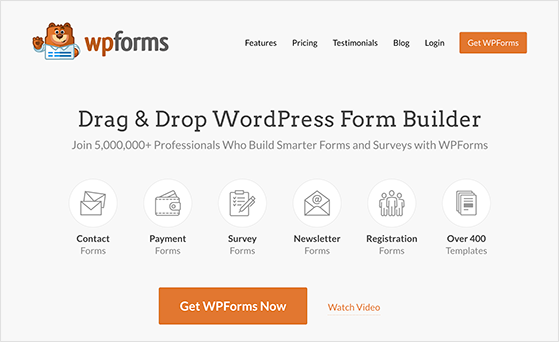
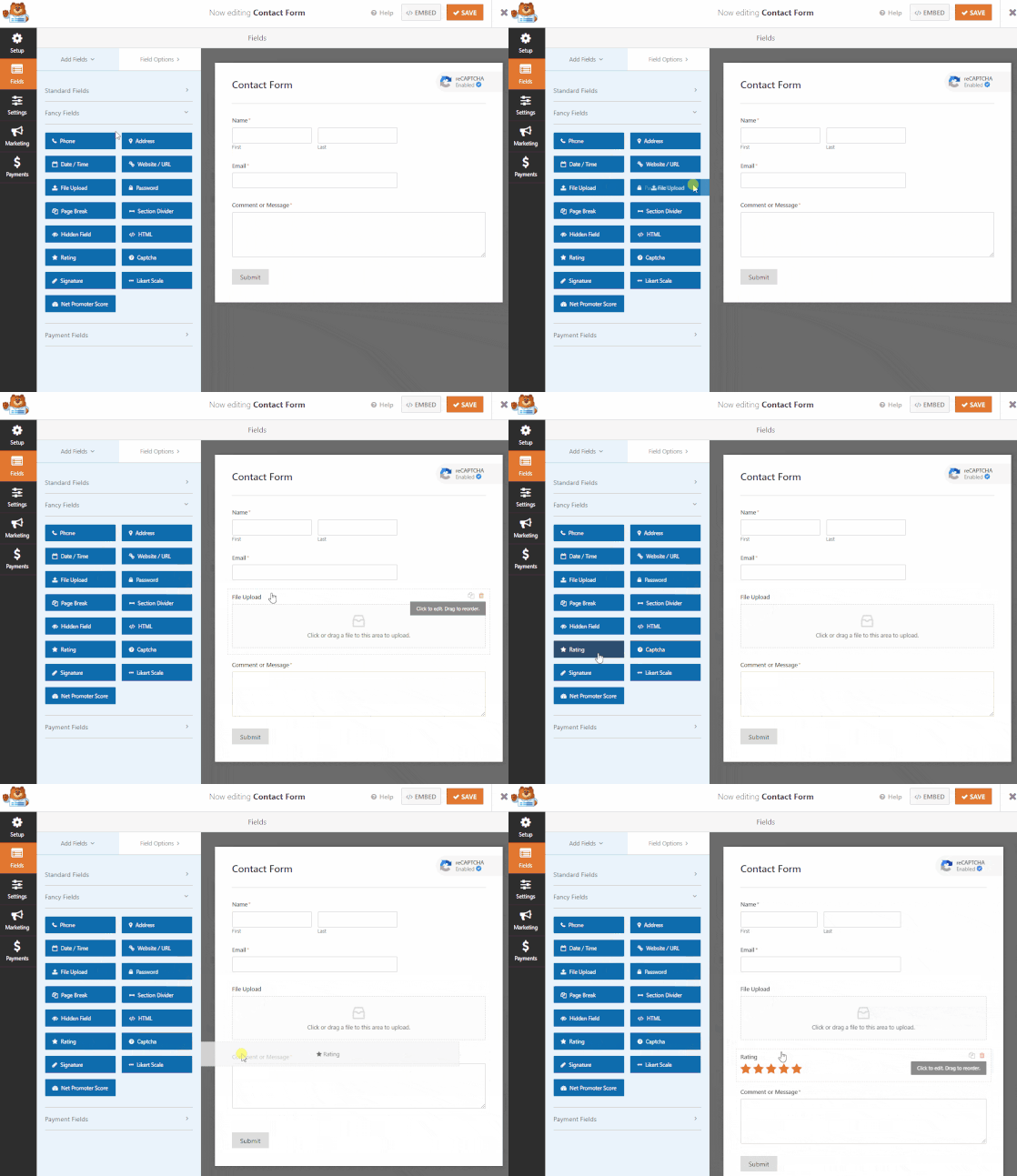
WPForms is a drag-and-drop WordPress form builder with over 6 million active installations. It covers everything from a basic contact form to payment forms, multi-step surveys, and conversational forms similar to Typeform.
The free version, WPForms Lite, includes the full drag-and-drop interface and enough field types to handle most contact form needs without upgrading.
I use WPForms on my own sites for every form I run, from contact pages to more involved multi-field setups. It’s the plugin I reach for first because setup is genuinely fast. Installing it, picking a template, and publishing a working form takes about five minutes.
What keeps me on WPForms long-term is the notification and confirmation system. You can set up conditional email routing so submissions go to the right person based on what the user selected. That’s the kind of detail that saves you from manually forwarding submissions every week.
The paid plans unlock 2,100+ templates organized by use case, payment integrations (Stripe, PayPal, Square, and Authorize.net), and connections to email platforms like Mailchimp, Constant Contact, and Campaign Monitor.
Upgrading also activates Lite Connect, which retroactively unlocks entries you collected on the free version.
| Pros | Cons |
|---|---|
| Fastest setup of any plugin tested | Advanced features require a paid plan |
| Free tier includes drag-and-drop builder | Lite version has limited integrations |
| Conditional logic available in paid plans | Can feel like overkill for a single contact form |
| Payment forms, file uploads, conversational forms | |
| Strong spam protection built in |
Verdict: WPForms is the right choice for most WordPress users. Whether you’re adding a contact form to a blog or building a multi-step intake form for a service business, it handles both without feeling like you’re fighting the tool.
2. Gravity Forms: Best for Power Users and Complex Workflows

| Feature | Details |
|---|---|
| Pricing | From $59/year (Basic); no free tier |
| Free Plan | No |
| Standout Features | • Advanced conditional logic • Developer-friendly hooks and filters • Calculations, quizzes, surveys • 40+ official add-ons • REST API access |
| Rating | A |
| Best For | Developers, agencies, complex multi-step workflows |
Gravity Forms has no free version, you pay from the first install, and it’s worth it if your forms need to do things most builders can’t handle.
It starts at $59 per year for a single site with basic add-ons, and it earns that price through depth of conditional logic, an extensive hook and filter system, and a mature ecosystem of official add-ons covering payments, CRMs, and more.
Testing Gravity Forms, the thing that stood out immediately is how precise the conditional logic gets. You can build forms where entire sections appear or disappear based on multiple combined conditions, trigger different notifications by field value, and route data to different third-party tools depending on what the user submitted. That level of control is hard to replicate in other plugins without custom code.
The tradeoff is that Gravity Forms is not built for beginners. The interface is functional rather than friendly, and getting the most out of it rewards people who are comfortable in WordPress settings panels and understand how their data needs to flow.
If you’re building a workflow-heavy form for a client site or an internal tool, that depth makes sense. For a simple contact form, it’s overkill.
| Pros | Cons |
|---|---|
| Most powerful conditional logic available | No free version or trial |
| Extensive add-on ecosystem | Steeper learning curve |
| Developer-friendly with hooks and REST API | Interface is dated compared to newer plugins |
| Active since 2010, mature and stable | Add-ons cost extra on lower-tier plans |
Verdict: Gravity Forms is the right pick if you need serious conditional logic, custom integrations, or developer-level control. It’s not the friendliest starting point, but for complex form builds it’s still the benchmark.
3. Fluent Forms: Best for Performance-Focused Sites
| Feature | Details |
|---|---|
| Pricing | Free; paid from $79/year (single site) |
| Free Plan | Yes |
| Standout Features | • Lightweight and fast by design • Conditional logic in free version • Multi-step forms (free) • 70+ integrations (paid) • Conversational form mode |
| Rating | A |
| Best For | Performance-focused sites, budget-conscious users who need logic |
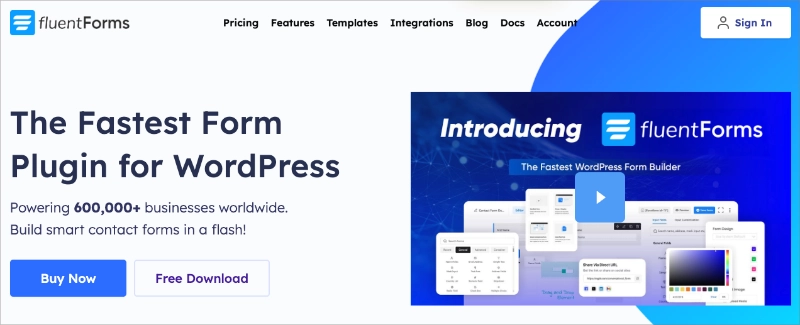
Fluent Forms is a drag-and-drop WordPress form builder built with a specific priority: it adds as little weight to your pages as possible.
The free version is more generous than most competitors, including conditional logic and multi-step forms without an upgrade. For sites where page speed is a concern, that combination is hard to beat at zero cost.
When I tested Fluent Forms, I was checking whether its “lightweight” positioning was real or marketing. It held up. A form rendered noticeably faster than equivalent forms in heavier plugins, with minimal JavaScript loading.
The builder itself is clean and quick to work in, though slightly less polished than WPForms in a few spots.
The free version covers a lot of ground: text fields, email, dropdowns, date pickers, file uploads, and a handful of payment fields.
Where it pulls ahead is conditional logic in the free tier. You get real show/hide field rules without paying, which WPForms and others reserve for paid plans.
Upgrading unlocks deeper integrations, post creation from form submissions, and advanced quiz functionality.
| Pros | Cons |
|---|---|
| Conditional logic available in free version | Fewer templates than WPForms |
| Lightweight, minimal JS footprint | Smaller support community |
| Multi-step forms included free | Some integrations require paid plan |
| Active development, improving quickly |
Verdict: Fluent Forms is the strongest value pick if performance matters and you need conditional logic without paying. It competes with WPForms directly on features, and its free tier is genuinely useful rather than a stripped-down teaser.
4. Formidable Forms: Best for Calculation-Heavy Forms
| Feature | Details |
|---|---|
| Pricing | Free (limited); paid from $39.50/year |
| Free Plan | Yes |
| Standout Features | • Calculation fields for quotes and estimates • Data display views (show submitted data on front end) • Conditional logic • Drag-and-drop builder • GDPR-compliant opt-in fields |
| Rating | A- |
| Best For | Mortgage calculators, quote forms, loan estimators, data-driven forms |
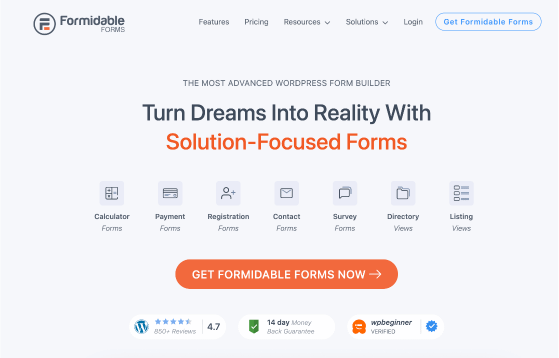
Formidable Forms is a WordPress form builder with a specialty: forms that calculate. If you need a mortgage estimator, a loan calculator, a price quote form, or any form where the output depends on math across multiple fields, Formidable Forms does that more naturally than Gravity Forms or WPForms, where you’d need more configuration to reach the same result.
Testing Formidable Forms, the calculation builder took some getting used to. You write formula expressions referencing field IDs, which is more technical than a typical drag-and-drop experience.
It’s not the friendliest interface for someone building their first form. But for the use cases it’s built for, it’s the most complete option.
The other differentiator is data views. Formidable can take submitted form data and display it back on your front end as tables, directories, or filtered lists. That’s a feature set closer to a simple application builder than a standard contact form plugin, which is why it attracts developers building interactive directories or client portals on WordPress.
| Pros | Cons |
|---|---|
| Best calculation fields in any form plugin tested | Free version is quite limited |
| Front-end data display views | Formula syntax has a learning curve |
| Affordable entry price at $39.50/year | Less beginner-friendly than WPForms |
| Good for building data-driven tools |
Verdict: Formidable Forms is the right choice when your form needs to do math. For standard contact or lead forms, something simpler will serve you better, but for calculators and quote tools it has no real competition in this price range.
5. Ninja Forms: Best Modular Option for Developers
| Feature | Details |
|---|---|
| Pricing | Free core; paid plans from $99/year |
| Free Plan | Yes |
| Standout Features | • Modular add-on system • Custom HTML and CSS in forms • Unlimited forms and fields (free) • Developer hooks and filters • Entry management and CSV export |
| Rating | B+ |
| Best For | Developers and users who need a customizable, extensible base |
Ninja Forms is a free WordPress form builder built around modularity. The core plugin gives you unlimited forms and fields at no cost, and you extend functionality through individual add-ons: conditional logic, front-end post submission, email marketing connections, payments. You pay for what you need rather than a fixed feature tier.
Testing Ninja Forms, I appreciated the developer-level access. You can drop custom HTML and CSS directly into form fields, which is genuinely useful for matching forms to a site’s design without fighting template constraints. The builder interface is clean and gets out of the way.
The add-on model has a real tradeoff though. If you need conditional logic, email integrations, and multi-step forms, the add-on costs stack up quickly. At that point you’re often paying more than WPForms or Fluent Forms. Both bundle those features into a single plan.
Ninja Forms makes more sense when you have a specific, narrow need rather than a general-purpose form setup.
| Pros | Cons |
|---|---|
| Unlimited forms and fields in the free version | Add-on costs add up quickly |
| Custom HTML/CSS directly in forms | Conditional logic requires a paid add-on |
| Developer-friendly architecture | Not ideal for users who want everything bundled |
| Active community and hook ecosystem |
Verdict: Ninja Forms works well when your requirements are specific and you’d rather buy individual add-ons than commit to a full plan. For general use, the bundled options give you more for the same money.
6. Contact Form 7: Best Free Option for Simple Contact Forms

| Feature | Details |
|---|---|
| Pricing | Free, always |
| Free Plan | Yes (only option) |
| Standout Features | • Completely free, no upsell path • 10+ million active installations • reCAPTCHA and Akismet spam filtering • AJAX-powered submissions • Supports multiple forms, file uploads, date fields |
| Rating | B |
| Best For | Simple contact forms with zero budget |
Contact Form 7 is the oldest and most downloaded WordPress form plugin, with over 10 million active installations and no premium upsell path. It is entirely free.
You configure forms by writing shortcode-like tags in a text field rather than dragging and dropping elements, which makes it less approachable than modern alternatives but also keeps it lean.
I’ve set up Contact Form 7 on plenty of client sites over the years, especially when budget was the deciding factor. It does what it says: creates working contact forms, sends email, and handles spam through reCAPTCHA and Akismet integration. There’s nothing wrong with it for that use case.
What you give up is everything else. No drag-and-drop builder, no templates, and no conditional logic.
Email marketing integrations require third-party add-ons. If you outgrow a basic contact form, Contact Form 7 becomes a constraint rather than a foundation. That said, for a simple “name, email, message” form that just works, it’s hard to argue against free.
| Pros | Cons |
|---|---|
| Completely free with no upsell | No drag-and-drop builder |
| 10+ million installs, extremely stable | Requires markup knowledge to customize |
| reCAPTCHA and Akismet spam protection | No conditional logic or templates |
| Lightweight, minimal page weight | Email marketing integrations need third-party add-ons |
Verdict: Contact Form 7 is worth installing if your only need is a basic contact form and your budget is zero. The moment you need more than that, a plugin with a proper free tier like WPForms Lite or Fluent Forms will save you time.
WordPress Form Builder FAQs
What is the best WordPress form builder for beginners?
WPForms is the best starting point for most beginners. Its drag-and-drop builder is the most intuitive of any plugin tested, the free version (WPForms Lite) includes real form-building features rather than just a teaser, and setup takes about five minutes. If budget is the priority and you can handle a slight learning curve, Fluent Forms gives you more free features including conditional logic.
What is better than Contact Form 7?
For most sites, WPForms Lite or Fluent Forms are better options than Contact Form 7. Both include drag-and-drop builders, form templates, and email notifications without requiring you to write shortcode syntax. Fluent Forms also includes conditional logic in its free version, which Contact Form 7 does not support natively. Contact Form 7 still works well if you’re comfortable with its markup system and only need a basic contact form.
Does WordPress have a built-in form builder?
WordPress does not include a form builder by default. The block editor has a basic search form block, but nothing that handles contact forms, email notifications, or field logic. For any real form, you need a plugin. The good news is that the most capable options all have free tiers, so you don’t need to spend anything to get started.
Is WPForms really free?
Yes. WPForms Lite is genuinely free and available from the WordPress plugin repository. It includes the drag-and-drop builder, basic field types, form templates, email notifications, and spam protection. The paid plans (starting at $49.50 per year) unlock advanced features like conditional logic, payment integrations, 2,100+ templates, and email marketing connections. Most simple sites can run on the free version indefinitely.
What is the fastest WordPress form builder?
Fluent Forms is the most performance-focused option of the plugins tested. It loads minimal JavaScript and avoids bloating your pages the way some larger plugins can. Contact Form 7 is also lightweight but lacks modern features. WPForms is well-optimized given its feature set. If page speed is a primary concern, Fluent Forms is the best balance of features and performance.
Level Up Your Lead Capture with Giveaways
Forms are one of the most reliable ways to grow your email list. A well-placed contact or opt-in form captures leads from people already on your site.
But if you want to grow your list faster, pairing a form plugin with a giveaway can make a real difference. Instead of waiting for people to find your form, a contest gives them a reason to sign up and share.
RafflePress lets you run viral contests directly in WordPress, with entry actions for email signups, social follows, and referrals. Most giveaways go live in under an hour.
Start with WPForms or Fluent Forms for your everyday forms, and add a RafflePress giveaway when you want a surge of new subscribers or a campaign moment to build around.
Related Guides
- How to Create a Survey on WordPress (3 Easy Methods)
- How to Set Up a Thank You Page in WordPress (6 Steps)
- How to Create a Landing Page in WordPress Step-by-Step
- Best WordPress Plugins to Grow Your Business
If you liked this article, please subscribe to our YouTube Channel for RafflePress video tutorials. You can also find us on Twitter and Facebook.

