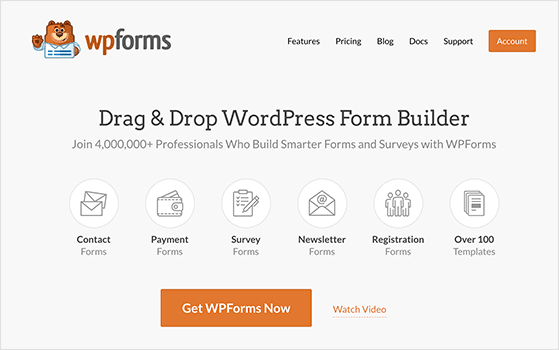
WPForms Review: Where It Wins and Where It Falls Short (2026)
John Turner
John Turner
TL;DR: WPForms is worth paying for if you need more than a basic contact form, and the free Lite tier is fine for testing the waters. Here is the short version of my review.
- Who it is for: Small businesses, bloggers, and beginners who want lead capture, payments, or surveys without hiring a developer.
- Free Lite tier: Builds simple forms with a handful of templates, but it does not store entries in your dashboard.
- Pricing: Pro is $199.50 for the first year (then $399 to renew); Basic starts at $49.50.
- Best features: Drag-and-drop builder, conditional logic, payment forms, and form abandonment recovery.
- The catch: Conditional logic and entry storage sit behind paid tiers, and renewal prices double after year one.
- Skip it if: You only need one static contact form on a tiny site and nothing else.
You need a form that does more than a basic contact box, and you would rather not hire a developer to build it. Maybe you want to take payments, capture leads, or run a survey.
After testing WPForms across my own sites, I think it is worth paying for if you fall into that group. In this review, I will show you what the free Lite tier really gives you, where the Pro version earns its price, and who should pick something else.
- WPForms Review: The Quick Summary
- Why Do You Need a WordPress Form Builder Plugin?
- Who Should Use WPForms?
- WPForms vs. The Main Alternatives
- How Does WPForms Work?
- WPForms Features: Form Building and Design
- WPForms Features: Growth and Marketing
- WPForms Features: Trust, Support, and Extras
- WPForms Pros and Cons
- WPForms Pricing: How Much Does WPForms Cost?
- Honest User Reviews and Testimonials of WPForms
- WPForms Frequently Asked Questions
- WPForms Review: Is WPForms Worth It?
WPForms Review: The Quick Summary
- Ease of use: The builder is genuinely beginner-friendly. You drag fields onto the form and see the result instantly.
- Affordability: The free version covers simple forms, and the paid plans are reasonably priced for the first year.
- Support: You get ticket-based support and detailed documentation, with priority support on Pro and Elite.
- My verdict: WPForms is a solid pick for most WordPress site owners, with a few real limitations I cover below.
Why Do You Need a WordPress Form Builder Plugin?
Almost every WordPress site needs a contact form plugin, whatever kind of site you run. A form is safer than publishing your email address in the open.
When you show your email address on a page, spammers and scrapers pick it up. A contact form keeps your address private and cuts down the phishing and junk that follows.
Forms also save time. You can ask visitors and potential customers for exactly the details you need and gather useful feedback in one step.
The better form plugins, like Ninja Forms and Gravity Forms, add extras such as a newsletter signup checkbox so you can follow up with people who reach out.
Free: Download Our Giveaway Playbook
Templates, prize ideas, and promotion strategies in one guide.
Who Should Use WPForms?
WPForms fits some sites far better than others. Here is where I would reach for it, and where I would not.
WPForms is a good fit if you are:
- A small business collecting leads, quotes, or bookings through a form.
- A blogger who wants to grow an email list with signup and survey forms.
- Selling something and want to take payments through Stripe, Square, or PayPal.
- A beginner who wants to build forms without touching code.
You can probably skip it if you are:
- Running a tiny site that needs a single static contact form and nothing more. WPForms can be more than that job needs, and the free Lite tier or a lighter plugin will do.
- A developer who wants deep extensibility and custom hooks. Gravity Forms gives you more room there.
I have seen people install the full Pro plugin for one contact form, then wonder why it feels heavy. If that is you, start with Lite and upgrade only when you actually hit its limits.
WPForms vs. The Main Alternatives
WPForms is not the only option, and it is not the right one for everyone. Here is where the two most common alternatives genuinely win.
Gravity Forms is the pick for power users and developers. It has a deeper add-on ecosystem and more advanced hooks for custom workflows, so if you need to build something unusual and you are comfortable in code, it gives you more headroom.
Google Forms wins on price and reach. It is free, it works outside WordPress, and it is hard to beat for a quick survey you want to share by link. What it does not do is live natively on your WordPress site or match your branding, which is exactly where WPForms is stronger.
If you want a form that feels like part of your WordPress site and connects to your email and payment tools without a separate dashboard, WPForms is the better fit.
How Does WPForms Work?
WPForms is a drag-and-drop WordPress form builder used on over 6 million sites. It lets you build everything from a simple contact form to complex forms for surveys, payments, and calculations.

To get started, you need to:
- Buy WPForms (Pro is the version I recommend for most sites).
- Install and activate the plugin.
Once it is installed, you can create contact forms yourself with the drag-and-drop builder. From there you can add features that help your site bring in more income.
WPForms Pro is built to help small businesses earn more online. It makes taking payments and collecting leads straightforward, with order forms that include Stripe and PayPal. Easier checkouts tend to mean more sales.
It also saves time managing customer information, so you can focus on the work that matters.
Is WPForms Worth the Investment?
For most small business sites, yes. Here is my reasoning.
You can run a basic site without a contact form builder, but without forms you get no leads. For most business owners, leads are the whole point of paying to keep a site online.
So the tools you use should help grow your revenue, and that is what WPForms Pro is built to do.
With over 6 million installs, WPForms is one of the most popular form plugins for WordPress. It also holds consistently high ratings on WordPress.org, with thousands of 5-star reviews. That tells you people like it, but you should still check that its features fit your site.

WPForms Features: Form Building and Design
These are the core building features you will use to create and style your forms.
Visual Drag-and-Drop Builder

The drag-and-drop builder is the part beginners notice first. You create forms straight from your WordPress dashboard with no code.
To add a field, I dragged it from the left side of the screen onto the form on the right. It is simple enough that a first-timer can build a working form in a few minutes.
You can embed any form with the built-in WordPress block or a shortcode, so you do not need a developer to publish it.
1,000+ Form Templates

You rarely need to build a form from scratch. WPForms ships with a large template library, including:
- Basic contact form
- Multi-page forms
- Payment forms
- Login forms
- Post submission forms
- Recruitment forms
- Newsletter signup forms
The templates match your existing WordPress theme for a consistent look. They also work with popular page builders like SeedProd and Elementor.
Online Order Forms

Order forms are one of the most useful money-making features in the paid version. You can take payments right on the form.
WPForms supports Stripe, Square, and PayPal, with Authorize.Net available on the Elite plan. That covers most of the payment options a small business needs.
Typeform-Style Conversational Forms

The Conversational Forms add-on turns a standard form into an interactive one that asks a single question at a time. With one click, the form feels more like a chat than a wall of fields.
“Conversational forms can create a more engaging experience, potentially leading to higher completion rates compared to traditional forms (Waymore, 2024).”
That format can lift completion rates, which is why I rate this add-on as one of the more practical extras.
Conditional Logic

Conditional logic shows or hides fields based on a previous answer. It is what makes a long form feel short, because people only see the questions that apply to them.
A good form builder should let you add logic like this quickly, and WPForms does. One thing to know is that conditional logic sits on the paid tiers, not Lite.
Spam Protection Tools

WPForms gives you several ways to keep spam off your forms. The built-in protections include:
- GDPR compliance
- hCaptcha
- Multiple reCAPTCHA options
- Custom Captcha
- The option to limit specific file upload types
Between these tools, you can cut bot and spam submissions down to a trickle.
WPForms Features: Growth and Marketing
This is where WPForms moves from a form plugin to a lead and revenue tool.
Form Abandonment

People get distracted mid-form. They take a phone call, open a new tab, or forget they were filling it out.
Those are lost leads, and capturing them is one of the better ways to grow your email list. The Form Abandonment add-on saves details people start entering but never submit.
You can set up an email alert for abandoned forms and follow up. With Save and Resume, visitors can stop part way, save their progress, and finish later.
Email Marketing Integrations

WPForms connects to the top email marketing services so you can send form submissions straight to your lists. Supported services include:
- Constant Contact (no add-on required)
- Mailchimp
- AWeber
- GetResponse
- Brevo (Sendinblue)
- ActiveCampaign
- Drip
- Campaign Monitor
You can also connect to other services through these integrations:
- Zapier: Link your forms with thousands of web apps.
- Uncanny Automator: Build workflows across multiple WordPress plugins.
- Salesforce: Send form contacts and leads to your CRM.
- Webhooks: Send entries to external tools without a third-party connector.
Surveys and Polls

The Surveys and Polls add-on is one of the features I find most useful for understanding an audience. It includes:
- Survey templates
- NPS surveys
- Star ratings
- Likert scale surveys
- Polls
- A reporting dashboard
Exporting the data is straightforward, which makes it easy to act on what you learn.
User Journey Discovery

The User Journey add-on shows where people went on your site before they hit submit. It is a useful way to spot which pages are doing the work of converting visitors.
Once you know what is working, you can repeat the same approach on other pages.
WPForms Features: Trust, Support, and Extras
These features cover the things that keep a form running smoothly once it is live.
User Registration
Letting people register on your WordPress site is handy for memberships, communities, and gated content. The User Registration add-on lets you build custom registration forms.
Visitors create profiles on your site through a form you control, rather than the default WordPress screen.
Guest Post Submissions

If you accept guest posts, the Post Submissions add-on is worth a look. It lets people submit user-generated content without logging in.
That makes it a practical tool for running a content marketing program with outside contributors.
Form Landing Pages

Much like RafflePress, WPForms doubles as a landing page tool. The Form Pages add-on turns any form into a distraction-free landing page in one click.
That is handy when you are running ads or a campaign and want the form to be the only thing on the page.
Customer Support and Notifications
Support is one of the stronger parts of WPForms. The team’s average response time is about 60 minutes, and the plugin holds thousands of 5-star reviews on WordPress.org.
There is also a large documentation library written with beginners in mind, plus step-by-step tutorials on the blog for most features.
On the form side, notifications let you email the person who submitted, or alert your own team on each entry. You can route those alerts to different people based on the answers, so a high-value lead and a small one can go to different inboxes.
More Useful WPForms Features
WPForms includes more than fits in one review. A few other tools worth knowing about:
- Salesforce integration: Syncs forms to a popular CRM for customer management.
- Offline forms: Saves entries if the connection drops, then submits when the user is back online.
- Multi-step forms: Break long forms into multiple pages.
- Geolocation: See where your users are based.
- Digital signatures: Collect electronic signatures on the form.
- Entry management: View, delete, and export your leads in one place.
- Form Locker: Set date and time limits or password-protect forms.
WPForms Pros and Cons
No plugin is perfect, and a review that only lists strengths is not much use. Here is the honest balance.
Pros:
- Beginner-friendly drag-and-drop builder with a large template library.
- Payment forms with Stripe, Square, and PayPal built in.
- Strong marketing integrations for email lists and CRMs.
- Form abandonment and Save and Resume help recover lost leads.
- Responsive support and detailed documentation.
Cons:
- The free Lite tier does not store entries in your dashboard.
- Conditional logic and most useful add-ons are gated to paid tiers.
- Renewal prices roughly double after the first year.
- It can be more than you need for a single static contact form.
WPForms Pricing: How Much Does WPForms Cost?
WPForms paid plans start at $49.50 for the first year. Here are the current tiers, with first-year sale pricing and what each plan renews at.
| Plan | First year | Renewal | Sites | Key features |
|---|---|---|---|---|
| Basic | $49.50/yr | $99/yr | 1 | Templates, entry storage, conditional logic, file uploads, spam protection |
| Plus | $99.50/yr | $199/yr | 3 | Adds email marketing integrations (Mailchimp, AWeber, and more) |
| Pro | $199.50/yr | $399/yr | 5 | Adds payments (Stripe, Square, PayPal), surveys, Save and Resume, Zapier |
| Elite | $299.50/yr | $599/yr | Unlimited | Adds Salesforce, HubSpot, webhooks, client management, multisite |
For most small business sites, I recommend the Pro plan. It is the tier where payments, surveys, and Save and Resume all unlock.
First-Year vs. Renewal: Does Pro Pay Back?
The price you see at checkout is the first-year price. Renewal is where it stings, because Pro jumps from $199.50 to $399 a year.
Whether that renewal is worth it comes down to one question: is your form earning more than it costs? If a payment form, recovered abandoned lead, or saved hour of admin covers $399 a year, Pro pays for itself.
If your form is a simple contact box that brings in the occasional message, the renewal is harder to justify, and Lite or Basic may be the smarter call.
WPForms Lite vs. Pro
There is a free version called WPForms Lite on WordPress.org. Lite gives you the core form fields and a handful of templates.
The catch worth flagging: Lite does not store form entries in your dashboard, so you rely on email notifications alone. If you want entry storage, conditional logic, payments, or marketing integrations, you need a paid plan.
Pro and Elite also include priority support, and every plan, free or paid, uses a mobile-responsive design.
Pairing WPForms With RafflePress
If your goal is email list growth, a form alone only captures the people who already want to hear from you. To bring in new signups faster, you can pair WPForms with a giveaway.
That is where RafflePress comes in. You run a giveaway where email signup is an entry action, and the contest gives people a reason to subscribe they would not have otherwise.

I have seen this combination pull in far more signups than a plain form on its own, because the prize does the convincing. WPForms collects steady leads day to day; a RafflePress giveaway gives you a spike when you need one.
Honest User Reviews and Testimonials of WPForms
User reviews tell you more than any feature list. Here is what real WPForms users say, good and bad.
“WPForms makes creating a form easy. I am fairly new to the software, however, the experience is just getting better. Even when you think a certain feature does not exist, there is always a plugin that will achieve what you are attempting.” — Phil D, review hosted on G2.com.
Ease of use: Reviewers consistently praise the drag-and-drop builder for letting them create forms without technical skills (WinningWP).
Reliability: Long-term users describe it as dependable over several years of use (Trustpilot).
Support: The support team is frequently called out for prompt, helpful responses (Trustpilot).
Integrations: Users appreciate the range of connection options for tying forms into their other tools (Trustpilot).
WPForms Frequently Asked Questions
Is WPForms good?
Yes, for most WordPress site owners. WPForms runs on over 6 million sites and holds thousands of 5-star reviews on WordPress.org.
Its drag-and-drop builder, large template library, and beginner-friendly setup are the main reasons people rate it highly. The main limits are that key features sit behind paid tiers and renewal prices rise after year one.
What is the difference between Google Forms and WPForms?
Google Forms is a free, standalone tool that works outside WordPress and is great for quick surveys shared by link. WPForms is a WordPress plugin that lives on your own site and matches your branding.
WPForms also connects to payment gateways, email marketing services, and CRMs, which Google Forms does not do natively. If your form needs to be part of your WordPress site, WPForms is the better fit.
Is WPForms free?
There is a free version called WPForms Lite on WordPress.org. It builds simple forms with the core fields and a few templates.
The main limit is that Lite does not store entries in your dashboard, so you rely on email notifications. Features like conditional logic, payments, and entry storage require a paid plan.
How much does WPForms Pro cost?
WPForms Pro is $199.50 for the first year, then renews at $399 a year, and covers up to 5 sites. It is the tier where payments, surveys, and Save and Resume unlock.
Cheaper plans start at $49.50 for Basic and $99.50 for Plus in the first year. All paid plans come with a 14-day money-back guarantee.
WPForms Review: Is WPForms Worth It?
After testing WPForms first-hand across my own sites, my answer is yes for most people. The forms are fast, SEO-friendly, and quick to build with the drag-and-drop editor.
It connects to the email tools, payment processors, and web apps a small business actually uses, which is what separates it from a plain contact form plugin.
I will be upfront: WPForms is part of the Awesome Motive family, same as RafflePress. I have kept this review honest about the limits anyway, because a recommendation is only useful if it tells you where a tool falls short.
So who should pass? If you only need one static contact form on a small site, the full plugin is more than the job needs, and the renewal cost will feel like money spent on features you never touch. Start with Lite, or a lighter plugin, and you lose nothing.
For everyone else, WPForms Pro is worth the first-year price, and it ships with a 14-day money-back guarantee if you change your mind.
If you found this review helpful, you may also like these roundups:
- Best WordPress Plugins to Grow Your Business
- Best WooCommerce Plugins to Boost Your Sales
- How to Choose the Best Coming Soon WordPress Plugin
- Best Social Media Plugins for WordPress
- Best WordPress Email Capture Plugins and Tools
Thanks for reading. If you liked this article, follow us on YouTube, Twitter, and Facebook for more from the blog.