How to Write Giveaway Rules: 7 Steps to Stay Legal and Avoid Disputes
 Stacey Corrin
Stacey Corrin
Stacey Corrin
 John Turner
John Turner
John Turner

TL;DR: How to Write Giveaway Rules
Writing giveaway rules comes down to six core areas that protect you legally and set clear expectations, plus a final review before you publish.
- Know your promotion type: Giveaways, contests, and sweepstakes each have different legal requirements.
- Set eligibility requirements: Spell out age limits, location restrictions, and employee exclusions.
- Define entry methods: List every action, set limits, and add a free entry option if any paid action is involved.
- Detail the prize: Include the approximate retail value (ARV), winner selection method, and notification deadline.
- Add legal disclaimers: No purchase necessary, void where prohibited, and state registration or bonding for New York, Florida, or Rhode Island prizes over $5,000.
- Review before publishing: Missing rules create legal exposure and disputes you can’t easily undo.
Your giveaway is built, the prize is chosen, and launch day is on the calendar. Then someone asks for the official rules. That’s when most organizers realize they haven’t written any.
Most people copy a giveaway rules template without knowing which state registration requirements apply, which platform rules they’re breaking, or that a prize over $2,000 can now trigger a tax form. Get one required element wrong and the whole promotion can unravel: a disqualified winner, a pulled campaign, or a fine you didn’t budget for.
In this guide, I’ll clear up the confusion and show you how to write giveaway rules that keep you on the right side of the law (and your audience).
- What Are Giveaways, Contests, and Sweepstakes?
- What Are the Rules Around Giveaways?
- Required Elements of Legal Giveaway Rules
- Giveaway Rules for Social Media Platforms
- How Do I Write Giveaway Rules?
- What Are the Most Common Giveaway Rules Mistakes?
- Giveaway Rules Template
- Simplify Your Giveaways with RafflePress
- Frequently Asked Questions About Giveaway Rules
What Are Giveaways, Contests, and Sweepstakes?
Giveaways, contests, and sweepstakes are three distinct promotion types, and the rules you write depend on which one you’re running. Over the years writing about giveaways, the mix-up I see most is treating a contest and a sweepstakes as the same thing.
Giveaways are the simplest. You choose winners randomly and entry is free. Dunkin’ UK ran a clean example: follow the account, like the post, tag a friend, then a winner is picked at random.
It’s beginning to look a lot like Christmas! We’re celebrating with a giveaway! Win 6 Dunkin’ baubles and 3 Dunkin’ vanity bags. To enter: follow @dunkindonutsUK, like this post, and tag a friend who loves Dunkin’. UK residents only. Closes 28/11 at 9am. Good luck!
Dunkin’ UK (@dunkindonutsUK), November 21, 2024
Contests involve skill or effort. You select winners based on merit, like a photo contest where the best entry wins, or a recipe competition judged by chefs.
Sweepstakes are random-draw promotions often regulated by law. Entries are free and winners are selected by chance. “Win a dream vacation” promotions fall here.
A lottery requires payment to enter, which is why your rules must always include “no purchase necessary.”
What Are the Rules Around Giveaways?
In the United States, the Federal Trade Commission (FTC) sets the rules for giveaways, contests, and sweepstakes. Its main goal is keeping things fair and protecting consumers.
The Lottery Test and No Purchase Necessary Rule
A promotion becomes an illegal lottery when all three of these elements are present at the same time:
- Prize: Something of value is awarded to a winner.
- Chance: Winners are selected randomly, not by skill.
- Consideration: Entrants must pay or make a purchase to participate.
Removing consideration is the legal basis for “No Purchase Necessary.” You must always offer a free way to enter.
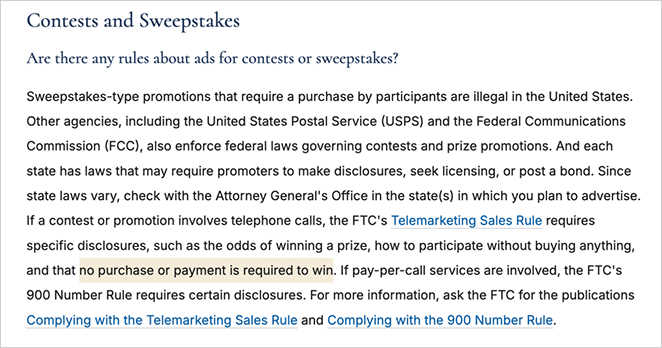
In some states, collecting marketing data can also count as consideration, so a genuine free entry path matters even when no money changes hands.
State Registration Requirements
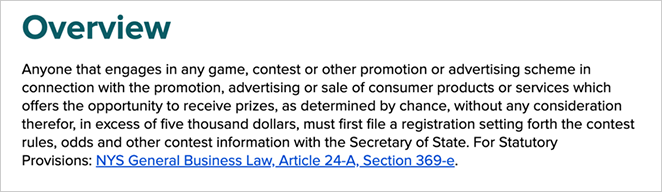
Two states require you to register your sweepstakes before launch if the prize value hits a certain threshold:
| State | Threshold | Where to Register | Deadline |
|---|---|---|---|
| New York | Prizes valued at $5,000+ | NY Department of State | Before launch |
| Florida | Prizes valued at $5,000+ | FL Dept. of Agriculture and Consumer Services (FDACS) | At least 7 days before launch |
Missing these deadlines creates real legal exposure. If your prize could reach $5,000 and you’re open to residents in either state, register first.
A few states go further than a simple registration:
- New York and Florida can also require a surety bond once the prize value passes $5,000, not just registration.
- Rhode Island has its own registration rule for retail sweepstakes.
- A common workaround is to exclude New York, Florida, and Rhode Island residents from eligibility so these requirements don’t apply.
Void Where Prohibited
Include “void where prohibited” in your official rules. Certain states and countries have laws that make some giveaway structures illegal there, and this phrase automatically excludes those jurisdictions.
Hawaii, Utah, and New York have stricter sweepstakes laws where additional restrictions apply.
If you’re thinking of going global, be prepared for a whole new set of rules. For giveaways involving EU residents, you need to consider GDPR. This law focuses on protecting personal data, so be clear about how you’ll use entrants’ information.
If you collect personal data from California residents, the CCPA and CPRA apply too. You need to tell entrants what you collect and honor requests to access or delete their data.
For more information, refer to the FTC’s guide on promotions and the GDPR official website.
Free: Download Our Giveaway Playbook
Templates, prize ideas, and promotion strategies in one guide.
Required Elements of Legal Giveaway Rules
Every giveaway needs the same core set of elements, but no two promotions trigger them in the same way. When I pulled together what other guides say about this, none of them put every required element and its trigger in one place, so here it is.
Use this as your pre-launch checklist. The right-hand column tells you when each element actually applies to your giveaway.
| Required Element | What It Covers | When You Must Include It |
|---|---|---|
| Sponsor identity | Business name, mailing address, and website | Always |
| Eligibility | Age, location, and employee and family exclusions | Always |
| Promotion period | Start and end dates with the time zone | Always |
| Entry methods and AMOE | Every required action, entry limits, and a free alternate method of entry | AMOE required only if any entry action involves a purchase |
| Prize and ARV | Full prize description and approximate retail value | Always |
| Odds of winning | A statement that odds depend on the number of eligible entries | Always for random-draw giveaways |
| Winner selection and notification | How and when you pick and contact winners, plus a claim deadline | Always |
| Tax disclosure | A note that prizes are taxable and may trigger a 1099-MISC form | Prizes with a fair market value over $2,000 (2026 onward) |
| No purchase necessary | A clear statement that no purchase is required to enter or win | Always for any chance-based promotion |
| Void where prohibited | Language excluding jurisdictions where the giveaway is not allowed | Always |
| State registration and bonding | Filing, and sometimes a surety bond, before launch | New York, Florida, or Rhode Island when the prize is $5,000+ |
| Platform disclosure | A line stating the platform does not sponsor or endorse the giveaway | When running on Meta, X, TikTok, or YouTube |
Giveaway Rules for Social Media Platforms
Before you publish, check the rules of the platform you’re running on. Each one layers its own requirements on top of the FTC rules, and breaking them can get your campaign pulled even when your official rules are solid.
Every time I update this guide, at least one platform has quietly changed its promotion rules. TikTok’s 2026 overhaul is the biggest yet, so read that one closely.
Here’s what each platform expects from your promotional rules:
- Instagram and Facebook: Your rules must state clearly that Meta doesn’t sponsor, endorse, or run your promotion. You can’t use personal timelines or friend connections as the official entry mechanism. Meta’s policies for Pages, Groups, and Events spell out the details.
- X (formerly Twitter): You can’t make reposts your only entry method, and you shouldn’t reward duplicate posts. Any entry-automation tool has to comply with the X API terms of service. See X’s guidelines for running promotions.
- TikTok: TikTok tightened its rules in 2026. Under its Giveaway and Promotions Policy (effective March 16, 2026), your giveaway must be entirely free, the prize must be worth under $500, and you can’t offer cash or gift cards. You also can’t require extra actions beyond entering, and your on-screen disclosures must state the winner-selection and eligibility criteria, the start and end time, and the number of winners. The standard “not sponsored by TikTok” line still applies.
- YouTube: You must follow YouTube’s contest policies. Your official rules go in the video description and must make clear that YouTube doesn’t sponsor the contest.
Platform rules and FTC rules both apply. In your official rules, add a line confirming the promotion follows the rules of each platform you run it on.
How Do I Write Giveaway Rules?
The seven steps below cover those six core areas, then a final review before you publish. Work through them in order, since each one feeds the next.
Step 1. Set Your Giveaway’s Scope and Location
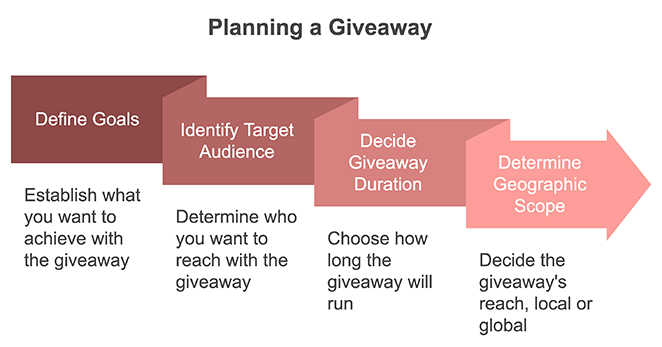
Before you write a single rule, decide where your giveaway will run and how long it will last. These two choices shape almost every rule that follows.
Start with location. Are you keeping it local, going nationwide, or opening it up globally? Your answer decides which state registration and platform requirements apply.
Then decide how long your giveaway will run. The dates you pick set your state registration deadlines, so lock them in early.
Step 2. Establish the Eligibility Criteria
Start with age restrictions. Clearly state any age limits and specify whether your giveaway is for adults only or open to teenagers too.
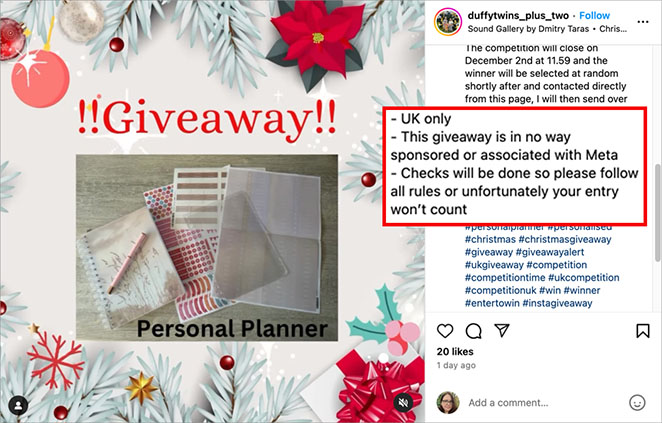
Next, define the location. Be specific about the boundaries you set earlier. Whether it’s US residents only or worldwide, spell it out.
As you can see in this example, the organizer clearly states that it’s open to UK entries only:
Don’t forget about employees. Preventing your employees and their family members from entering is standard practice. It keeps things fair and avoids any appearance of bias.
Step 3. Outline the Entry Methods
Now let’s look at how people can enter your giveaway. This is where you get specific about what participants need to do.
Common entry methods include:
- Following your social media accounts
- Liking or sharing a post
- Submitting a form with contact information
- Tagging friends in comments
- Signing up for a newsletter
- Creating user-generated content (like photos or videos)
Be clear about each step. Instead of “follow us on social media,” specify “follow @YourBrand on Instagram and Twitter.”
If any entry action involves a purchase or paid service, you must also offer an Alternate Method of Entry (AMOE) to satisfy “no purchase necessary” compliance. This is typically a free mail-in option.
Example language: “To enter without purchase, mail a 3×5 card with your name and address to [Sponsor Address].” Include the AMOE in your official contest rules whenever any paid element exists.
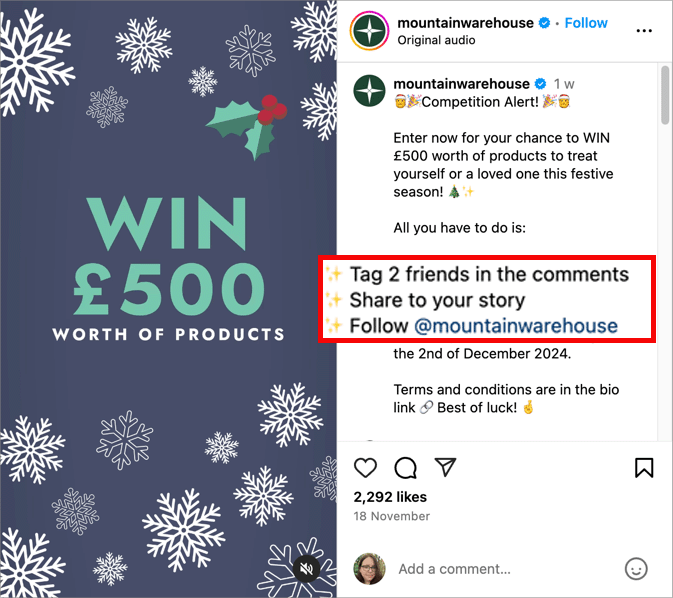
Mountain Warehouse doesn’t just list their profile. They tag it so it’s easier for users to click and follow them:
If you’re using multiple entry methods, explain whether they’re all required or if each one counts as a separate entry.
Avoid vague instructions. “Enter as many times as you want” could lead to spam, so set clear limits like “One entry per person per day.”
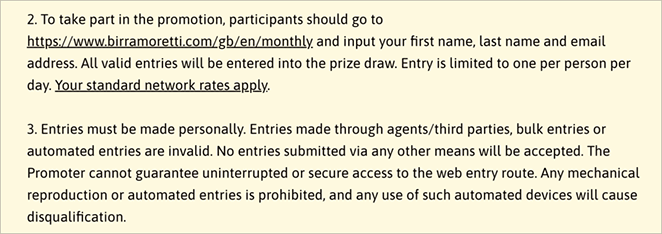
I particularly like how Birra Moretti uses a dedicated terms and conditions page to clearly outline their requirements. It keeps everything in one place and easy to access:
The easier and clearer your entry method, the more likely people are to participate. Always balance simplicity with your giveaway goals.
Step 4. Specify the Prize Details
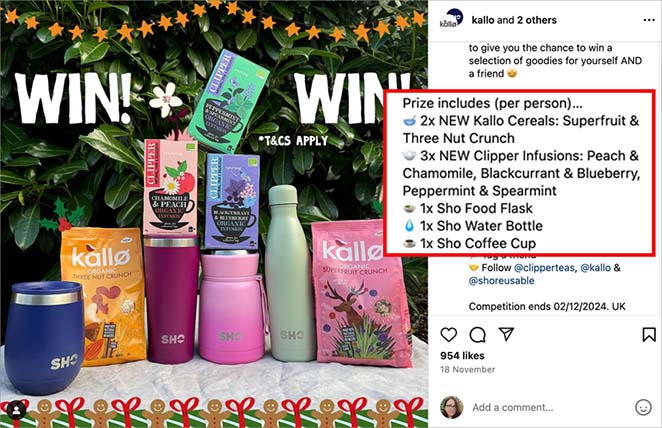
Start with a description of what you’re giving away. Is it a product, a service, or an experience? Be specific and highlight what makes it valuable.
Include key information like:
- The exact quantity of prizes
- The retail value of each prize (approximate retail value, or ARV)
- Any variations (like color options or sizes)
- Delivery method (shipped, digital download, in-person pickup)
Don’t forget to mention any restrictions. If the prize is a trip, specify whether it includes airfare or just accommodation.
For prizes awarded from 2026 onward, the sponsor must issue a 1099-MISC form once a prize’s fair market value passes $2,000. That threshold used to be $600, so this is a recent change under the One Big Beautiful Bill Act.
Either way, winners owe income tax on the prize’s fair market value, even when no form is issued. This matters most for high-value prizes like trips, electronics bundles, or cash.
Include a tax disclosure in your rules so winners understand the obligation before they enter. Adding high-quality images or videos of the prizes can also increase excitement, since people love to see what they might win.
If you’re offering multiple prizes, clearly explain how you’ll distribute them. Is there one grand prize and several runner-up giveaway prizes?
Step 5. Detail the Winner Selection Process
Being clear about how you’ll pick giveaway winners builds trust and keeps things fair.
Here’s what to include:
- Selection method: Random draw or judging criteria?
- Timing: When you’ll choose and announce winners
- Notification process: How you’ll contact winners
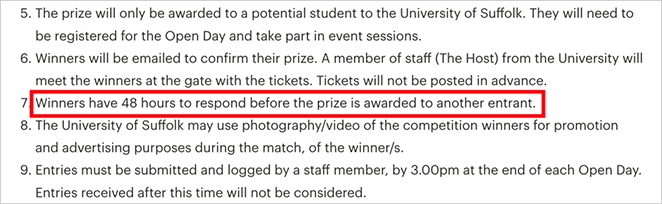
Set a deadline for claiming prizes. Something like “Winners have 48 hours to respond” works well.
Spell out how you’ll announce the winner publicly, whether that’s a post, an email, or both. If there’s a chance of ties, explain how you’ll break them, which matters most for skill-based contests.
Also mention whether you’ll select backup winners. Be specific about when they’re activated: if the selected winner fails to respond within the claim deadline, fails an eligibility check, or submitted a fraudulent entry.
Document every disqualification decision in case the outcome is challenged later.
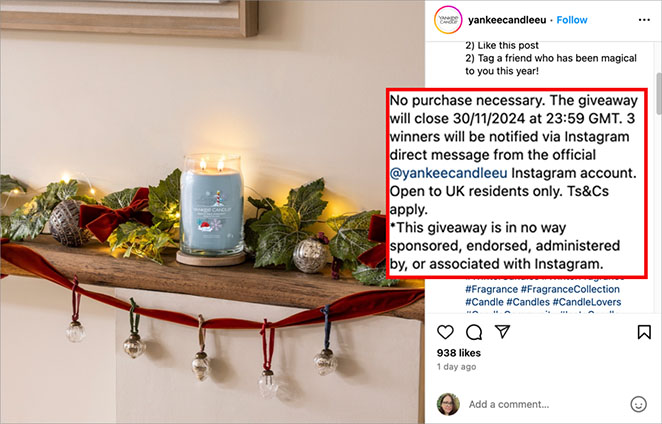
Step 6. Include Necessary Legal Disclaimers
Legal disclaimers protect your giveaway and your business from problems that may arise. They make sure everyone knows the contest terms and conditions and help you keep your giveaway legal.
Your official contest rules should include:
- A liability disclaimer stating participants can’t hold you responsible for issues related to the giveaway or prizes.
- Odds of winning: for a random draw, state that the odds depend on the number of eligible entries received. This is a named element in official rules, not optional.
- A data use statement explaining how you’ll use entrants’ information. Link to your full policy if you have one.
- If people submit content, a statement explaining that you can use it for promotion.
- A repeat of who is eligible to enter.
- “Void where prohibited” to cover jurisdictions where your giveaway may not be allowed.
Keep the language simple and clear.
Step 7. Review and Finalize Your Rules
Read through your sweepstakes official rules carefully. Look for any mistakes, confusing parts, or missing info. Reading out loud or asking someone else to check can help.
Make sure you’ve included all the key details:
- How to enter
- What people can win
- Who can join
- How you’ll pick winners
- Important dates
Also check that your rules match what you wanted to achieve with your giveaway.
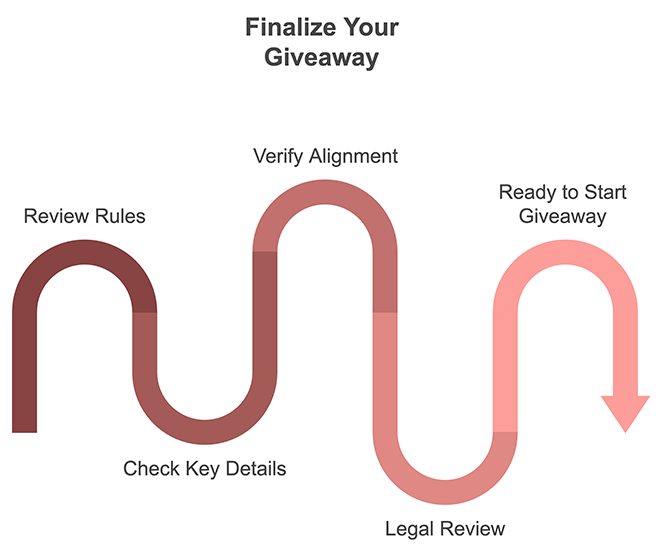
If you can, ask a lawyer to look over your rules. They might spot legal issues you didn’t notice, which can prevent problems later.
When everything looks good, you’re ready to start your giveaway.
Skip the legal guesswork and launch your giveaway today
RafflePress builds your entry forms, runs a fair winner draw, and generates compliant official rules from your details, all inside WordPress.
Create My GiveawayWhat Are the Most Common Giveaway Rules Mistakes?
Over 13 years writing about giveaways, I keep seeing the same compliance gaps come up again and again. Here are the ones most likely to cause real problems:
- Creating an illegal lottery: Requiring purchase with no free entry option turns your promotion into an illegal lottery in most US states. Always include a no-purchase-necessary path.
- Omitting the AMOE: If any entry action involves a paid service, you must provide an alternate method of entry (AMOE). Skipping this is one of the most common compliance violations.
- Skipping state registration: If your prize exceeds $5,000 and you’re open to New York or Florida residents, you need to register before launch. Missing this deadline creates real legal exposure.
- Violating platform policies: Meta, TikTok, and YouTube each have distinct promotional rules. Breaking them can get your campaign taken down even if your official rules are otherwise compliant.
- No tax disclosure: Prizes with a fair market value over $2,000 can require a 1099-MISC. Failing to disclose the tax obligation can surprise winners and damage your brand’s credibility.
- Vague winner notification language: Rules that don’t specify a claim deadline or backup winner process are an open invitation for disputes. Name the timeline and the procedure explicitly.
Giveaway Rules Template
Use this fill-in-the-blank block as the starting point for your contest terms and conditions. Replace each bracketed field with your specific details.
- Sponsor: [Your business name, mailing address, and website URL]
- No Purchase Necessary: No purchase or payment is necessary to enter or win. A purchase will not improve your chances of winning.
- Eligibility: Open to legal residents of [country/state], aged [X] or older as of the promotion start date. Employees of [Sponsor] and their immediate family members are not eligible.
- Promotion Period: Begins [Start Date] at [Time] [Time Zone] and ends [End Date] at [Time] [Time Zone].
- How to Enter: [Describe each required entry action. If any action involves a paid service, add: “To enter without purchase, mail a 3×5 card with your name and address to [Sponsor Address].”]
- Prize: [Describe prize(s) in full, including approximate retail value (ARV).] Total ARV: $[amount]. No substitution or transfer of prizes permitted except at Sponsor’s sole discretion.
- Winner Selection: Winner(s) will be selected by [random draw / judging panel] on or about [Selection Date]. Odds of winning depend on [number of eligible entries received / judging criteria].
- Winner Notification: Winner(s) will be notified by [email / direct message / phone] within [X] days of selection. Winner must respond within [48 hours / X days] to claim the prize. Failure to respond will result in disqualification and selection of an alternate winner.
- Void Where Prohibited: This promotion is void where prohibited or restricted by law.
- Liability Disclaimer: By entering, participants release [Sponsor] from any liability arising from participation in this promotion or acceptance of the prize. This promotion is not affiliated with, sponsored by, or endorsed by [Platform Name, if applicable].
If you’d rather not start from scratch, you can build from one of our ready-made giveaway templates and add your rules on top.
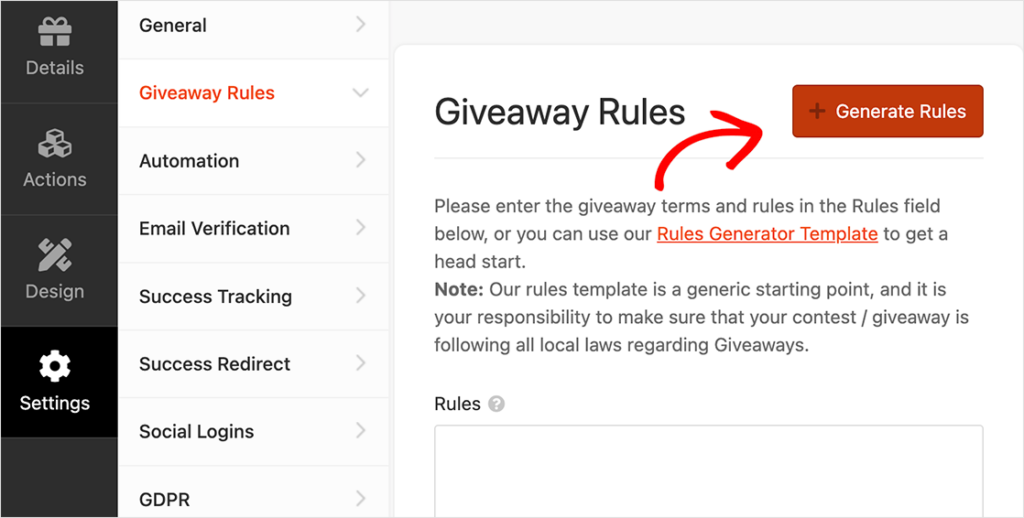
RafflePress generates these promotional rules automatically. Enter your sponsor name, prize details, eligibility requirements, and entry methods, and the built-in rules generator produces a complete set of official contest rules covering all FTC-required elements in about two minutes.
Simplify Your Giveaways with RafflePress
RafflePress is a WordPress giveaway plugin that lets you run viral contests to grow your email list and social following, without a subscription fee. Here’s how it handles each step we’ve covered.
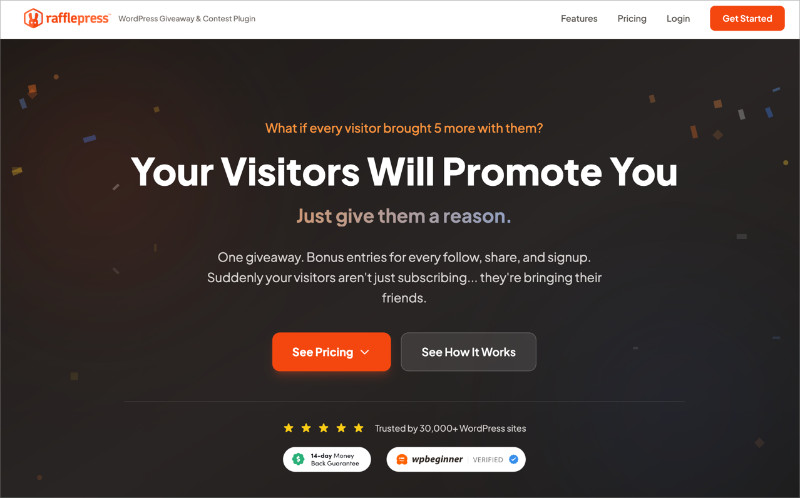
If you intend to run a giveaway on your WordPress website, here’s what RafflePress gives you:
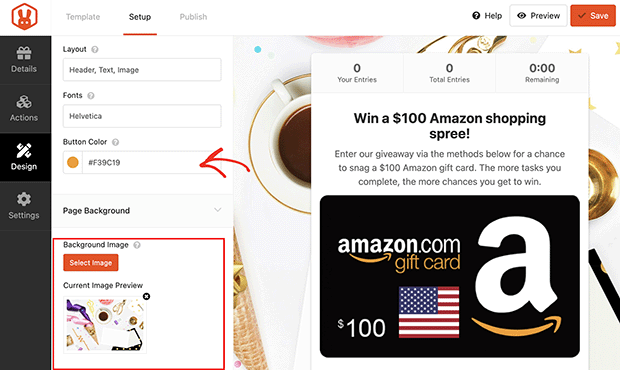
- Defining scope: Pick from goal-specific templates (list growth, social follows, product launch) and the giveaway configures itself to match.
- Entry methods: Choose from 30+ entry actions, including social follows, newsletter signups, video views, referrals, and custom actions, then set per-action entry limits to control spam.
- Prize details: Display prizes with images, descriptions, and ARV directly on the giveaway widget so entrants see exactly what they’re competing for.
- Winner selection: Use the built-in random winner picker to choose winners fairly, with full documentation of the selection.
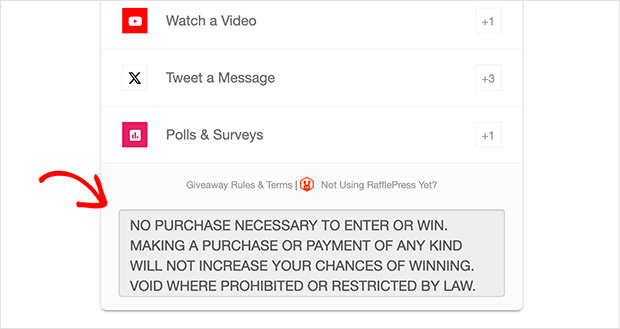
- Legal disclaimers: The built-in rules generator produces compliant official rules covering no purchase necessary, eligibility, entry methods, and prize details in about two minutes.
- Review and finalize: Preview your giveaway before it goes live to catch any issues before launch.
The rules generator is the piece I’d point a beginner to first. It turns the whole checklist above into a filled-out document in about two minutes.
Don’t just take my word for it. Here’s what Scott Gardener, owner of Agile Marketing Services, says:
“I’m a huge proponent of using email lists and try to make sure all my clients use them. RafflePress is a fun and easy way to build or add to your list. With just one contest, I added to one client’s list by over 50%.”
Over 200,000 WordPress sites run their giveaways with RafflePress. Get started and you can have your first giveaway live before the end of the day.
Frequently Asked Questions About Giveaway Rules
Do giveaway rules need to include an alternate method of entry?
Yes, if any entry method involves a purchase or paid service. The alternate method of entry (AMOE) gives people a free way to enter, which “no purchase necessary” compliance requires.
A common AMOE is a mail-in entry, like mailing a 3×5 card with your name and address to the sponsor. If every entry action is already free, you don’t need an AMOE, but you still state that no purchase is necessary.
Where should I post or link my official giveaway rules?
Publish your full rules on a page you control, usually a dedicated terms and conditions page on your own website. Then link to that page from every place the giveaway appears: the entry form, the social posts, and the landing page.
Social platforms limit how much text you can show, so a short summary in the caption plus a link to the full rules keeps you compliant without cramming everything into one post.
Can one set of giveaway rules cover Instagram, Facebook, and TikTok, or do I need separate rules per platform?
One core set of official rules can cover all of them, as long as it includes each platform’s required disclosure. You add a line naming every platform the giveaway runs on and confirming none of them sponsor or endorse it.
If a platform has a unique requirement, like TikTok’s on-screen disclosures, fold that into the same rules rather than writing a whole separate document.
How long should I keep my giveaway rules and winner-selection records after the giveaway ends?
Keep your published rules, entry list, and winner-selection notes for at least three years. That matches the general IRS record-keeping window and covers most dispute or tax questions that come up after a giveaway.
If your prize triggered a 1099-MISC, hold on to that paperwork for as long as you keep your other tax records.
Beyond staying legal, what makes a giveaway actually succeed?
A relevant prize does most of the work. A prize your ideal audience genuinely wants pulls in real potential customers, while generic cash or a new phone pulls in freebie hunters who unsubscribe the moment it ends.
After that, it comes down to clear entry steps, a real promotion plan, and following up with everyone who entered, not just the winner.
Launch a Compliant Giveaway Today
Your rules are ready. Now set up the giveaway itself, and let RafflePress handle the entry forms, the fair winner draw, and the compliant rules generator so you can launch today.
For more advice on running successful giveaways, see the following guides:
- How to Use Good Giveaway Copywriting to Drive Entries
- 12 Proven Ways to Get Free Content for Your Website
- How to Create a Distraction-Free Giveaway Landing Page
If you liked this article, please subscribe to our YouTube Channel for RafflePress video tutorials. You can also find us on Twitter and Facebook.


