How to Fix reCAPTCHA Not Working in WordPress (10 Easy Tips)
 Stacey Corrin
Stacey Corrin
Stacey Corrin
 John Turner
John Turner
John Turner
TL;DR: How to Fix reCAPTCHA Not Working in WordPress
reCAPTCHA most often fails due to a key mismatch, a missing domain registration, or a plugin conflict. Here are the fastest fixes:
- Check plugin settings – Make sure reCAPTCHA is enabled in your plugin before anything else
- Verify your API keys – Confirm your site key and secret key match exactly in Google’s admin console
- Check domain registration – Your domain must be listed in the Google reCAPTCHA admin console
- Test for plugin conflicts – Deactivate other plugins one by one until reCAPTCHA loads correctly
- Clear your cache – Clear both browser and site caches; cached scripts are a common culprit
- Check for JavaScript errors – Open your browser console and look for reCAPTCHA-related error messages
Trying to fix reCAPTCHA not working in WordPress? I’ve hit this on my own sites, and it usually comes down to a key mismatch, a missing domain registration, or a plugin conflict.
This guide covers 10 fixes that work through each cause in order. Whether you’re seeing a blank checkbox, an “invalid domain” error, or a silent verification failure, there’s a solution here.
- Why reCAPTCHA Isn’t Working in WordPress
- reCAPTCHA v2 vs v3: What’s the Difference?
- How to Fix reCAPTCHA Not Showing or Loading in WordPress
- 1. Enable reCAPTCHA in Your WordPress Plugins
- 2. Verify Your reCAPTCHA Keys
- 3. Check Your reCAPTCHA Domain Registration
- 4. Resolve Plugin Conflicts
- 5. Check for Conflicting Themes
- 6. Update Plugins and WordPress
- 7. Test with Different Browsers
- 8. Clear Your Cache and Disable Optimization
- 9. Whitelist reCAPTCHA in Security Plugins
- 10. Address JavaScript Errors
- FAQs on How to Fix reCAPTCHA Not Working
- Next, More Ways to Protect Your Site
Why reCAPTCHA Isn’t Working in WordPress
reCAPTCHA stops working on WordPress sites for a few specific reasons: a key mismatch between your plugin settings and Google’s admin console, a missing or incorrect domain registration, a plugin conflict where two reCAPTCHA scripts load and clash, or cached scripts that prevent the latest version from loading.
The good news is that most of these problems are quick to identify. The steps below work through each cause in order, starting with the most common.
reCAPTCHA v2 vs v3: What’s the Difference?
reCAPTCHA v2 is the checkbox version most people recognize. Users click “I’m not a robot” or complete an image challenge, and Google verifies them directly.
reCAPTCHA v3 works invisibly in the background. Instead of showing a challenge, it analyzes user behavior and assigns a risk score between 0.0 and 1.0. If the score falls below your plugin’s threshold (usually 0.5), the form submission gets blocked with no visible challenge shown.
The problem with v3 is that failures look like permission errors, not reCAPTCHA errors. Silently rejected submissions or a “Google reCAPTCHA verification failed” message with no visible challenge are both signs of a v3 score issue.
Most WordPress plugins like WPForms support both versions. If you’re troubleshooting v3, try lowering the score threshold in your plugin settings first. If that doesn’t help, switch to v2 temporarily to confirm reCAPTCHA is the cause.
Free: Download Our Giveaway Playbook
Templates, prize ideas, and promotion strategies in one guide.
How to Fix reCAPTCHA Not Showing or Loading in WordPress
Now that we’ve identified some potential causes, let’s look at how to fix reCAPTCHA not working in WordPress. We’ve got some easy and effective solutions.
1. Enable reCAPTCHA in Your WordPress Plugins
Often, you may find that reCAPTCHA is not working because it isn’t enabled in your WordPress plugins. This is a fairly common mistake and is remarkably easy to resolve.
You simply need to visit your plugin settings page and ensure that reCAPTCHA is activated.
If you’re having trouble finding the reCAPTCHA settings, don’t worry. Most plugins have a clearly labeled option for it.
In RafflePress, for example, just edit any giveaway and click on the Settings tab. Once there, click the ‘Recaptcha’ heading and click the toggle to enable Invisible Recaptcha.
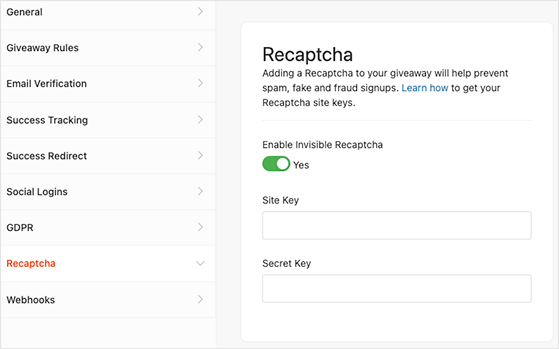
RafflePress includes reCAPTCHA in every giveaway out of the box, so once it’s configured in your settings, it protects your contests automatically. If you haven’t run a giveaway before, this guide walks through the full setup.
Similarly, popular WordPress form builders, like WPForms, have different reCAPTCHA versions in the settings for each form. So whether you’re creating a registration form or contact form, you can quickly enable it with a few clicks.
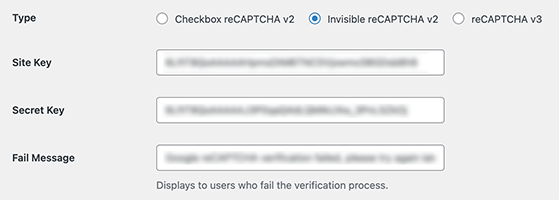
If you can’t find the option in your plugin, try checking its documentation or help guide for extra assistance. After enabling reCAPTCHA, save the changes to ensure your work isn’t lost.
After you’ve made sure that reCAPTCHA works across your WordPress plugins, head over to your website and test to see if everything functions correctly.
✅ Make sure reCAPTCHA is actually turned on in your plugin settings. It’s one of the most common (and easiest) fixes.
2. Verify Your reCAPTCHA Keys
Perhaps you’ve tripped over a common stumbling block: mistyping your reCAPTCHA keys. It’s easy to key in the wrong characters or reverse your site and secret keys.
Be sure that your site key and secret key in your WordPress plugin settings align exactly with what your Google reCAPTCHA account displays.
If this doesn’t work, you can generate new keys from the Google reCAPTCHA admin console.
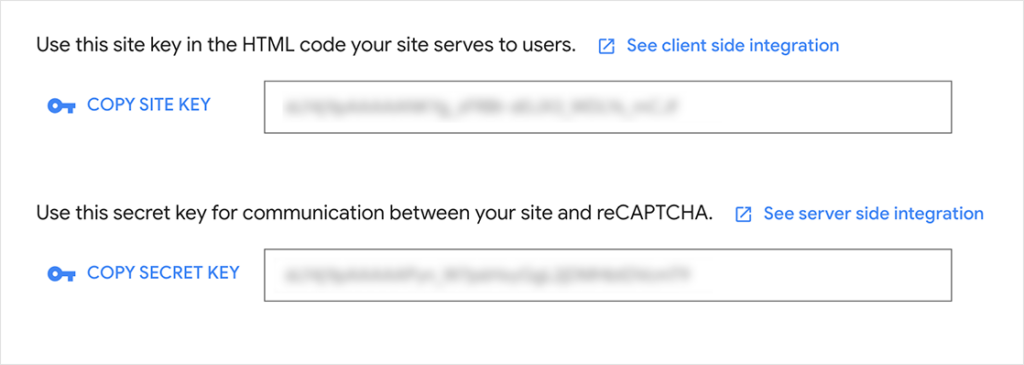
Then, you can update your plugin settings with a fresh set of keys, removing the chance of a key mismatch being your problem.
✅ Double-check that your site key and secret key match exactly. Even a small typo will break reCAPTCHA.
3. Check Your reCAPTCHA Domain Registration
Google’s reCAPTCHA tool won’t function correctly unless you’ve registered your domain on its reCAPTCHA admin console. You may even see an error like “invalid domain for site key.”
To fix this, you’ll need to add or edit your domain under the “Domains” section in the admin console. This confirms the connection between your WordPress site and Google’s reCAPTCHA service.
Follow the steps below to verify your domain registration:
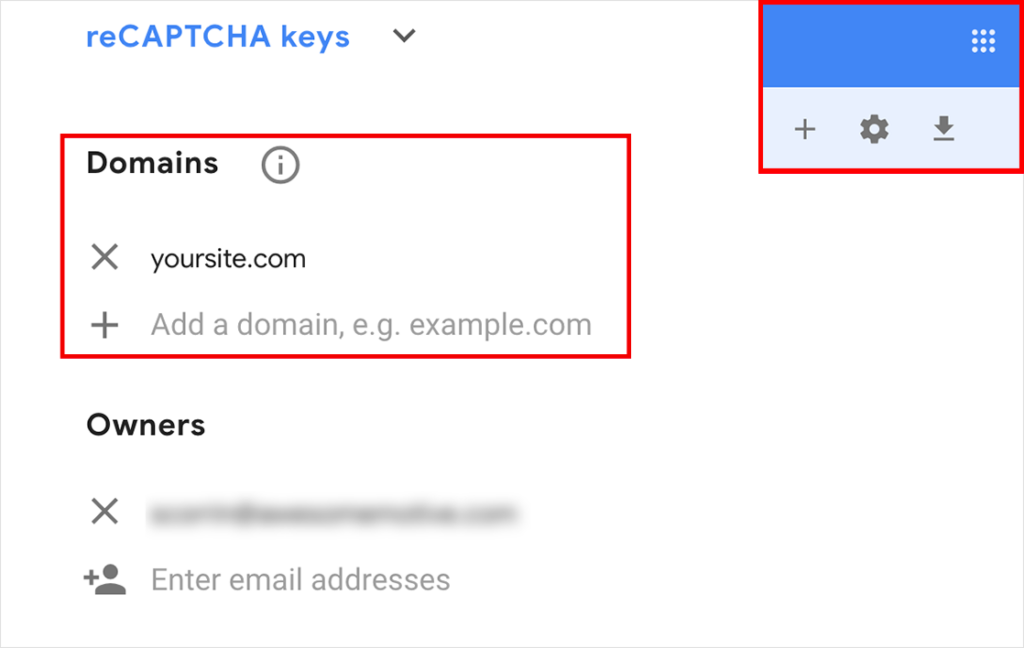
- Log in to your reCAPTCHA admin panel on Google’s site.
- Find your site on the admin panel and click on the settings gear icon.
- Under the “Domains” section, check if your site’s domain is listed. If it’s not (or if it’s incorrectly entered), add or edit the domain.
- Make sure to click on “Save” after making any changes.
Once you’re done, Google can verify that reCAPTCHA is working on your website.
Fixing the “Error for Site Owner: Invalid Domain for Site Key” Message
If you see the message “Error for site owner: invalid domain for site key,” your domain isn’t registered or isn’t matching what Google has on file. This is the most common cause of reCAPTCHA failing site-wide, and it’s a one-minute fix.
Go to your reCAPTCHA admin console, find your site, and click the Settings gear icon. Under “Domains,” check that your domain is listed exactly as it appears in your browser’s address bar.
Common mismatches to look for:
- Including “www.” when you registered without it, or vice versa
- Using a bare IP address instead of the domain name
- Forgetting to include a subdomain if your forms run on a subdomain like shop.yourdomain.com
Add the correct domain, save, and reload your page. The error should clear immediately.
✅ Make sure your domain is listed in the Google reCAPTCHA admin panel, or it won’t connect properly to your site.
4. Resolve Plugin Conflicts
If you have multiple plugins on your site with reCAPTCHA features, it could potentially lead to plugin conflicts. For example, you may have reCAPTCHA enabled in RafflePress for giveaways and in WPForms to combat form spam.
In this situation, it’s a good idea to temporarily disable these plugins to see if there’s a conflict triggering the problem.
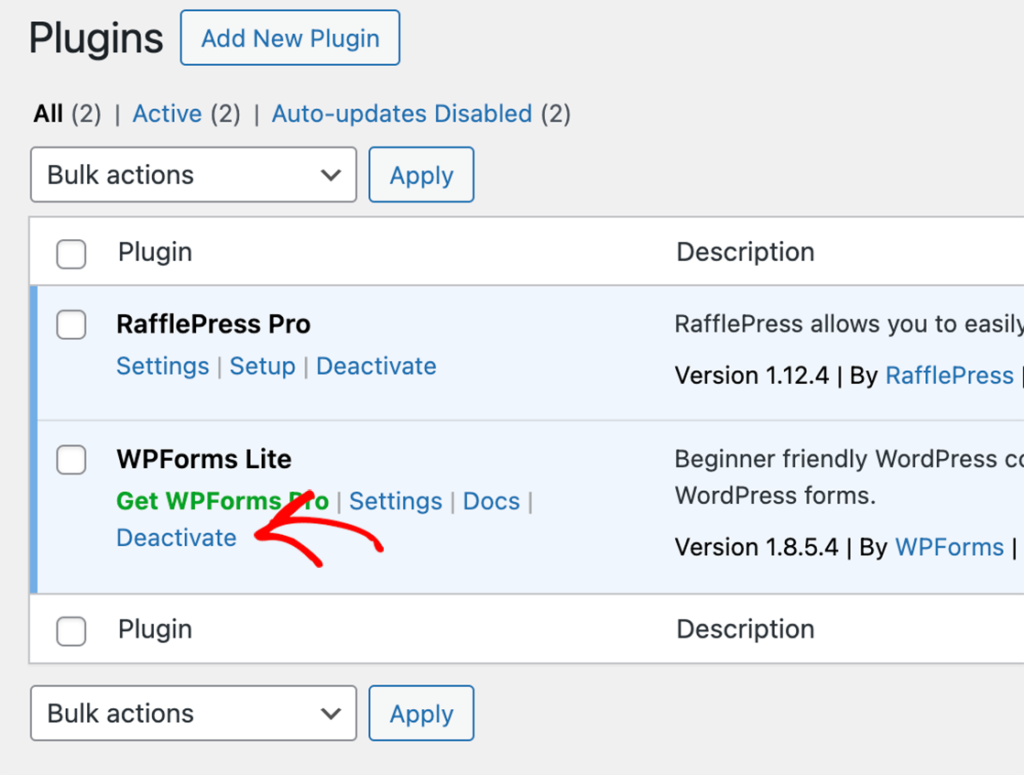
Remember to look for specific reCAPTCHA settings within the plugins. Sometimes disabling those options can fix the issue.
Once you’ve found the problem plugin, you can either decide to keep it deactivated or look for an alternative that fulfills the same role without causing any issues.
✅ If multiple plugins are using reCAPTCHA, try disabling them one by one. They could be clashing in the background.
5. Check for Conflicting Themes
Themes can sometimes interfere with reCAPTCHA not working in WordPress. Therefore, you should rule this out when troubleshooting.
To begin, activate a default WordPress theme like Twenty Twenty-Five. Switching to a different theme can reset some WordPress settings, possibly fixing your reCAPTCHA problem.
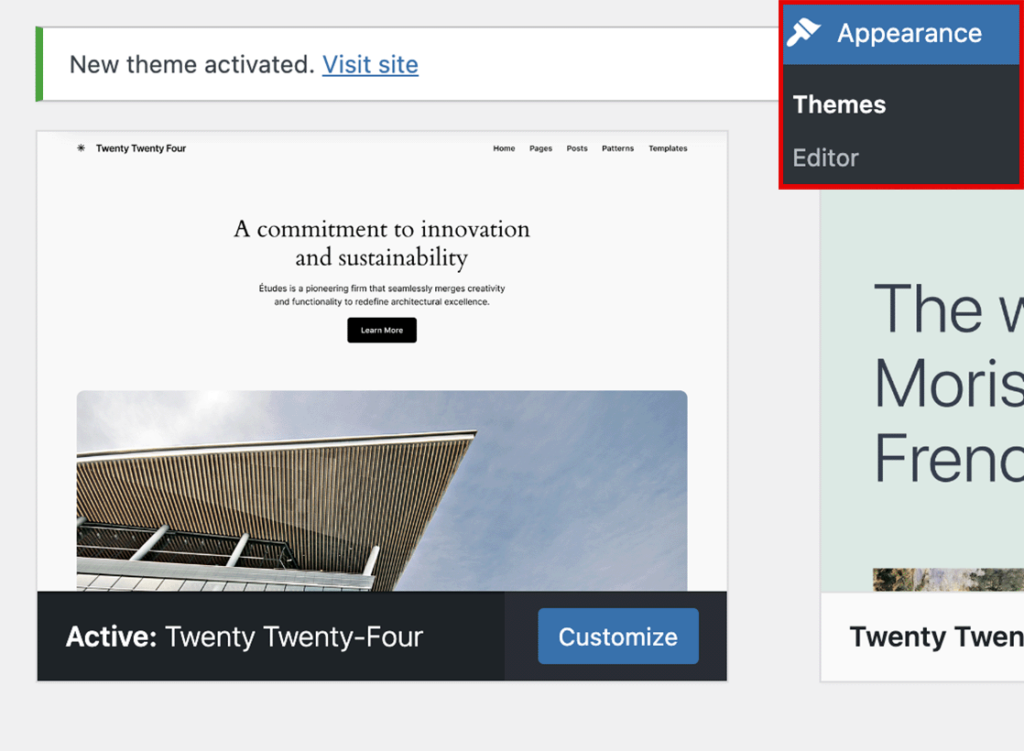
With the default theme active, test the reCAPTCHA again. If it’s working this time, your original theme might be the culprit.
Reach out to the theme developer about the issue. In many cases, they can offer a solution or patch to resolve the conflict. For more control, consider creating your own custom WordPress theme.
If reCAPTCHA is still not working, then it’s safe to switch back to your original theme. The issue likely isn’t theme-related, meaning you should return to the list of solutions and continue testing.
✅ Your active theme could be blocking reCAPTCHA scripts. Switch to a default theme like Twenty Twenty-Five to test.
6. Update Plugins and WordPress
Another potential cause for reCAPTCHA not working could be down to an outdated version of WordPress and plugins that need updating. Outdated software can often cause problems that are easy to fix by updating.
To update your WordPress plugins, navigate to Plugins » All Plugins from your WordPress dashboard. Here, you can update each plugin individually or select each checkbox and choose the bulk ‘update all’ option.
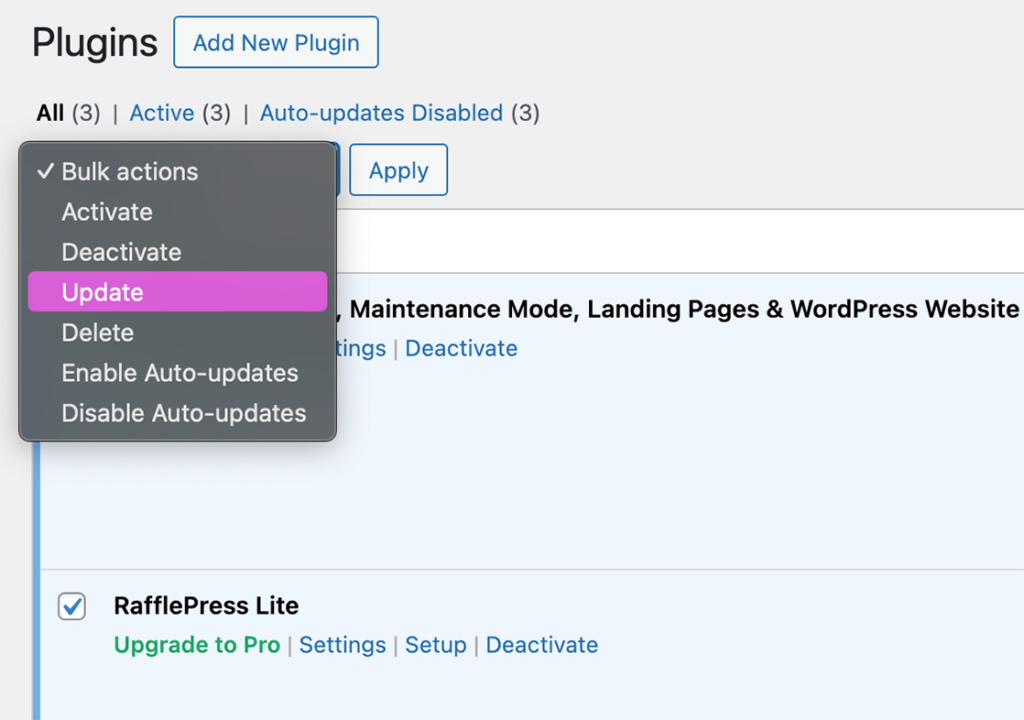
Remember, it’s crucial to back up your WordPress site before updating, just in case something goes wrong.
Updating to the latest version of WordPress is just as easy. Just go to the ‘Updates’ section of your WordPress dashboard, and if an update’s available, you’ll see a notification to do so.
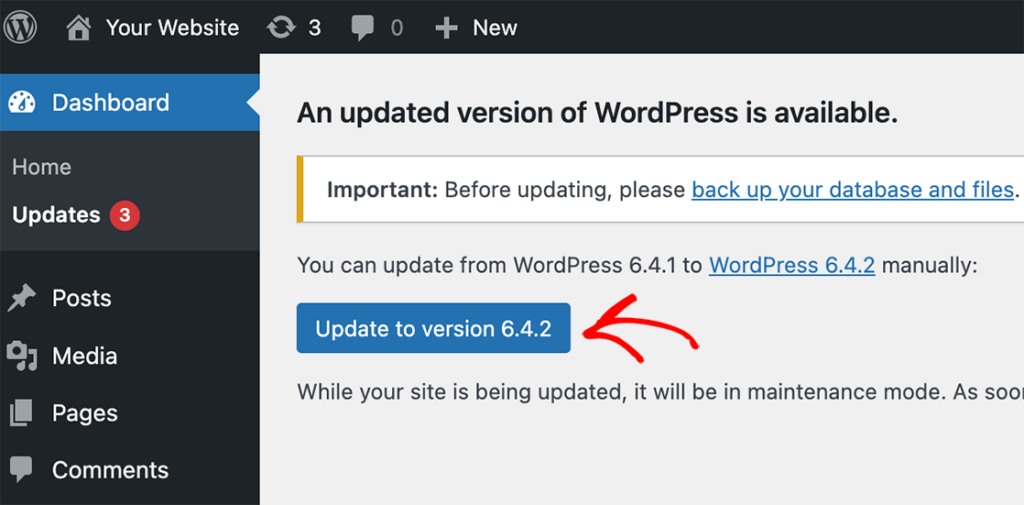
Simply click the ‘Update Now’ button, and your WordPress version will refresh. After updating WordPress and your plugins, verify if the reCAPTCHA works properly.
If reCAPTCHA still doesn’t work, the issue might lie elsewhere. If that’s the case, move on to the next potential solution.
✅ Outdated plugins or WordPress versions can break reCAPTCHA. Always run updates after testing other fixes.
7. Test with Different Browsers
One troubleshooting tip is to test reCAPTCHA on different browsers. Browsers interpret your site’s code differently, so if you’re experiencing issues, it could be related to the browser you’re using.
To rule out browser-specific issues, we recommend trying different options, such as Chrome, Firefox, Safari, and Edge. Ensure you’re using the latest edition of these web browsers to keep compatibility and performance in check.
When using reCAPTCHA with a different browser, watch closely for differences or improvements.
If reCAPTCHA works well on one browser but not on another, you can focus your troubleshooting efforts on that particular one. For instance, you can see if enabling or disabling add-ons makes a difference or if adjusting browser settings resolves the issue.
The fastest way to rule out browser extensions is to open your site in a private or incognito window. If reCAPTCHA loads there, a browser extension is blocking it. Ad blockers like uBlock Origin, privacy tools like Privacy Badger, and VPN browser extensions all commonly intercept Google’s reCAPTCHA scripts. Disable them one at a time until reCAPTCHA loads normally.
If you’re running a VPN or proxy, try disabling it and reloading the page. reCAPTCHA uses IP reputation signals, and some VPN exit nodes are flagged as high-risk. If reCAPTCHA passes immediately after disconnecting, the VPN was the cause.
Here are quick browser-specific fixes to try:
- Chrome: Disable extensions one at a time, then clear site data (Settings > Privacy > Clear browsing data)
- Firefox: Disable strict tracking protection for the site and check if DNS-over-HTTPS is blocking reCAPTCHA
- Safari: Go to Safari > Settings > Privacy and temporarily disable “Prevent cross-site tracking”
✅ Test in an incognito window and with your VPN off. These two checks alone resolve a lot of browser-side failures.
8. Clear Your Cache and Disable Optimization
Another way to fix reCAPTCHA not working is to look at your browser cache. Cached data from previous visits is stored locally to make pages reload faster.
Those stored files can sometimes cause problems. Outdated cached scripts are a common reason reCAPTCHA stops loading correctly.
To resolve this, you’ll need to clear your browser cache. Different browsers have different methods for doing this.
Depending on the browser you’re using, you might find this option in the settings, privacy, or history menu.
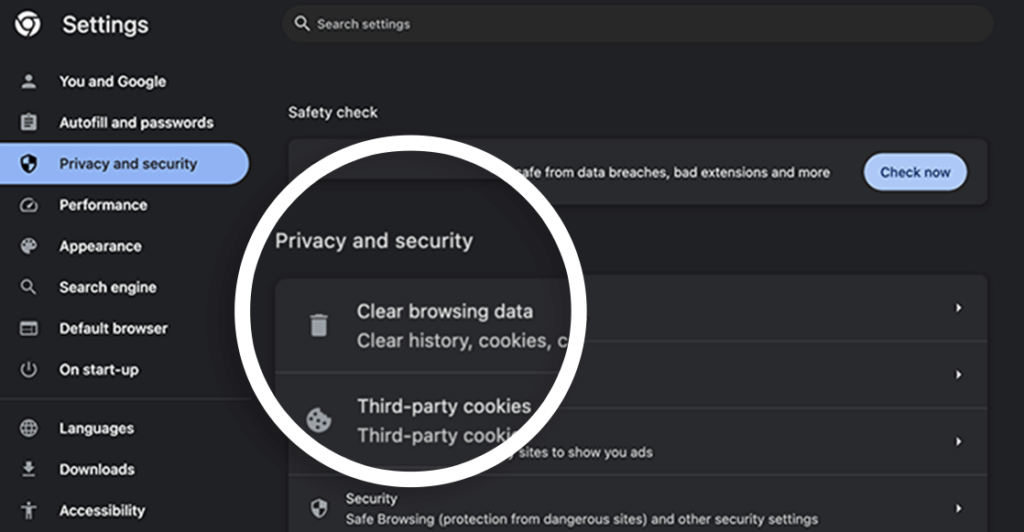
By carrying out this step, you’ll ensure that your browser loads the most recent version of the webpage, including any updates or changes made to reCAPTCHA.
The same goes for any caching plugins you’re using. From your WordPress dashboard, find your caching plugin and clear it.
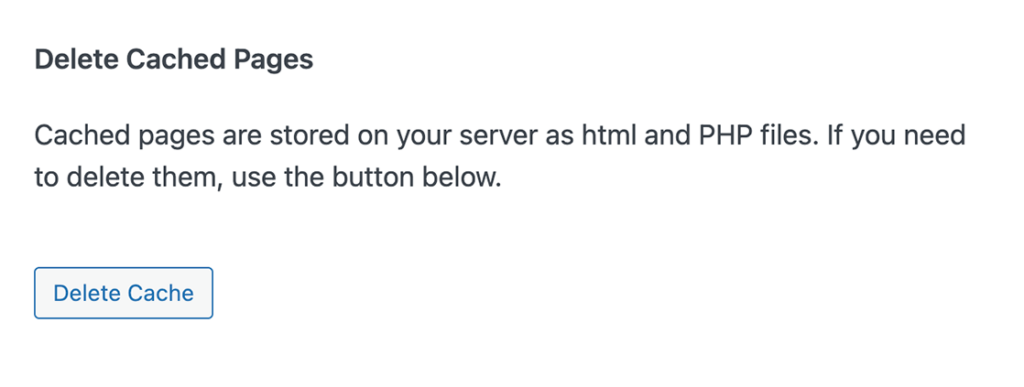
Beyond that, enabling JavaScript optimization or minification features in your plugins or theme could also meddle with reCAPTCHA.
If you’re using any plugins or themes with these features, consider deactivating them for a while to see if reCAPTCHA starts working.
Once you’ve carried out these fixes, reload your site and see if reCAPTCHA works again. If not, there’s still more troubleshooting you can do, which we’ll dive into next.
✅ Clear both browser and plugin caches, and disable JavaScript optimization. Cached scripts often break reCAPTCHA display.
9. Whitelist reCAPTCHA in Security Plugins
If you’re still having trouble with reCAPTCHA not working, the next tip is to look at your security and firewall plugins. They’re designed to protect your site but are sometimes overzealous, blocking legitimate scripts like reCAPTCHA.
To fix this, you can whitelist reCAPTCHA URLs in your plugin settings. Look for an option that allows you to create exceptions or to whitelist specific scripts and add Google’s reCAPTCHA to this whitelist.
Remember: you’re not compromising your security by doing this. You’re simply telling your security system to treat reCAPTCHA as a friend, not a threat.
✅ Your firewall or security plugin might be blocking reCAPTCHA. Whitelist its script URLs to prevent this.
10. Address JavaScript Errors
If you’ve taken the previous steps and reCAPTCHA is still not working, you might be encountering JavaScript errors. For diagnostic purposes, your browser has a developer console that you can access.
In Chrome for Windows, press Ctrl + Shift + J or Ctrl + Shift + I. Or on Mac, type Cmd + Opt + J or Cmd + Opt + I to open the console.
Use the console to look for any error messages that mention reCAPTCHA or a script loading failure.
When using the developer console, look for any error message that refers to “reCAPTCHA.” These will usually highlight a code line or script causing the issue.
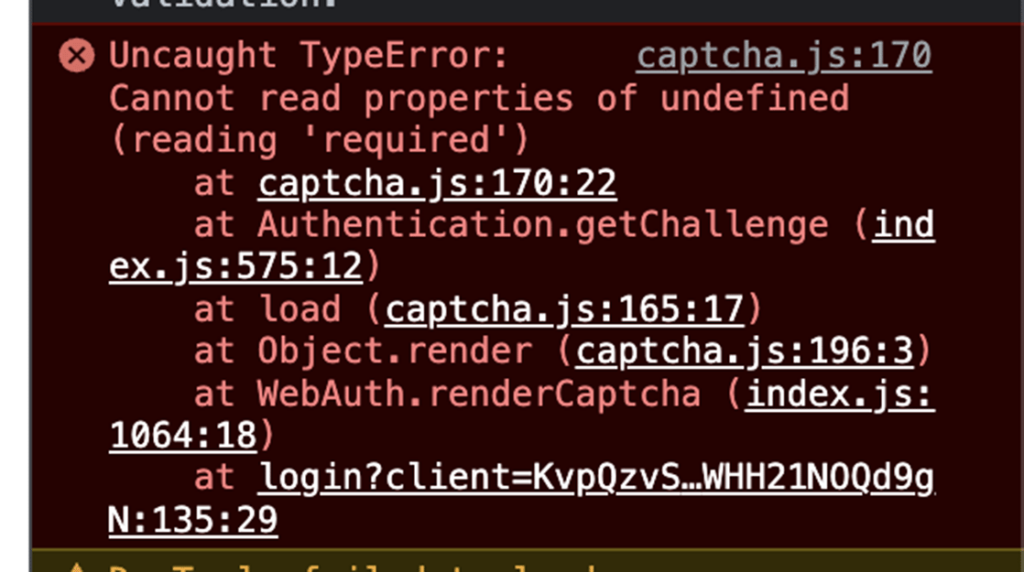
If you find a JavaScript error mentioning reCAPTCHA, check whether another plugin’s script is conflicting on the same page. Deactivating other plugins one at a time while testing the affected page will usually surface the conflict.
If you’re still stuck, consult your reCAPTCHA plugin’s documentation or support team for help resolving the specific error.
✅ Use your browser’s developer console to check for reCAPTCHA-related JavaScript errors. They’ll point to the exact issue.
FAQs on How to Fix reCAPTCHA Not Working
Here are some common questions and answers on how to fix reCAPTCHA not working in WordPress.
What to do if reCAPTCHA keeps failing?
If reCAPTCHA keeps failing after completing the checkbox or image puzzle, it usually means Google has flagged your IP or browser as suspicious. Try clearing your browser cache, switching to a different network, or disabling your VPN. If it fails only on your site and not others, the problem is likely a script conflict or a caching issue on your WordPress install.
Why is my browser blocking reCAPTCHA?
Browsers don’t block reCAPTCHA directly, but privacy extensions and strict tracking protection settings do. Ad blockers like uBlock Origin, privacy tools like Privacy Badger, and Firefox’s strict tracking protection mode all intercept Google’s reCAPTCHA scripts. Test in a private or incognito window first to confirm, then disable your extensions one at a time to find the one causing the issue.
How do I fix the “invalid domain for site key” error in WordPress?
This error means your WordPress site’s domain isn’t registered under your reCAPTCHA API key. Log into the Google reCAPTCHA admin console, select your site, and open the Settings gear. Under “Domains,” add your exact domain without https:// and without a trailing slash. Double-check for www vs. non-www mismatches, then save. The error should clear on the next page load.
Does reCAPTCHA v3 work differently than v2 in WordPress plugins?
Yes, they work very differently. reCAPTCHA v2 shows the familiar checkbox or image puzzle. reCAPTCHA v3 runs invisibly and scores each user from 0.0 to 1.0 based on behavior. If the score falls below the threshold your plugin sets (often 0.5), the submission gets blocked with no challenge shown. If you’re seeing form submissions silently rejected, that’s usually a reCAPTCHA v3 score issue.
How do I test reCAPTCHA after fixing it?
Fill out the form on your site as a real visitor would. For v2, you should see and be able to complete the checkbox or image challenge. For v3, there’s nothing visible, but your form submission should go through without a “verification failed” error. You can also check Google’s reCAPTCHA admin console to view traffic graphs and confirm successful challenges are appearing after your fix.
reCAPTCHA issues in WordPress almost always come down to a key mismatch, a plugin conflict, or a caching problem. All of those you can fix in a few minutes with the steps above.
If you’re running a giveaway on your site, RafflePress has invisible reCAPTCHA built into every contest, so you can stop spam without adding friction for real participants. Get RafflePress and run your first contest today.
Next, More Ways to Protect Your Site
We hope this guide helped you learn how to fix reCAPTCHA not working. You may also find the following tutorials helpful for protecting and enhancing your WordPress website:
If you liked this article, please subscribe to our YouTube Channel for RafflePress video tutorials. You can also find us on Twitter and Facebook.


